EMAIL:
wr@insulatedpipeline.com


Published:2024-06-17 | Last Updated: 2025-09-10 Views: 238

i. Introduction
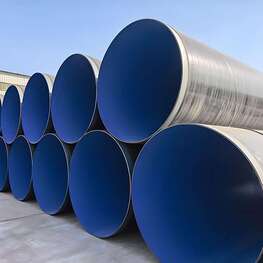
Fusion bonded epoxy coating steel pipe is a steel pipe with a uniform, dense, anti-corrosion coating formed by spraying or coating the surface with fusion-bonded epoxy powder and curing it at high temperatures.
Epoxy coated pipe combines the high strength of steel pipe with the corrosion resistance of an epoxy coating and is widely used in water supply, hot water, steam, chemical, and municipal engineering applications.
ii. Common parameters of fusion bonded epoxy coating steel pipe
| No. | Parameter Name | Parameter Range / Value | Remarks |
|---|---|---|---|
| 1 | Outer Diameter (OD) | 21.3 mm – 1219 mm | Common sizes cover small- to large-bore pipelines |
| 2 | Wall Thickness (WT) | 2.0 mm – 40 mm | Selectable according to pressure rating and service environment |
| 3 | Nominal Length | 6 m / 12 m / 18 m / customizable | Epoxy coated steel pipe in standard lengths for easy transportation and installation |
| 4 | Standards | ISO 14713, GB/T 8163, API 5L | Manufactured per international or national standards |
| 5 | Material | Q235, Q345, API 5L Gr.B – X70 | Common carbon or low-alloy steels |
| 6 | Internal & External Coating Thickness | Outer FBE: ≥250 µm; Inner liner: optional | Provides corrosion protection and wear resistance |
| 7 | Working Pressure | ≤10 MPa | Determined by OD and wall thickness |
| 8 | Service Temperature | –20 °C – 80 °C | Higher temperature possible with modified FBE |
| 9 | Bending Radius | ≥5 × pipe OD | Prevents coating cracking during installation |
| 10 | End Connection | Beveled / Threaded / Flanged | Chosen according to construction requirements |
| 11 | Weight | Depends on OD & WT; e.g. DN100×6 m ≈ 45 kg | Convenient for transport and cost estimation |
| 12 | Corrosion Resistance | Salt-spray test ≥ 500 h | Plastic coated steel pipe offers excellent corrosion resistance |
| 13 | Bending Performance | Bend radius not less than 10 D (pipe OD) | Ensures coating integrity under bending |
| 14 | Wear Resistance | No damage after 5 000 abrasion cycles | FBE coated pipe is abrasion-resistant |
| 15 | Coating Adhesion | ≥ 250 N | Strong adhesion, difficult to peel off |
iii. Production Process Flow Chart for Epoxy Coated Pipe

iv. Application areas of fusion bonded epoxy coating steel pipe
| Application Field | Typical Scenario | Description |
|---|---|---|
| Municipal Water & Sewer | Urban water-supply networks, sewer networks | Fusion-bonded epoxy coating on steel pipe, combined with internal and external plastic coatings, prevents corrosion and scaling, which helps safeguard water quality. |
| Building Engineering | High-rise water-supply systems, fire-fighting pipes, hot & cold water lines | Offers high pressure and corrosion resistance with long service life. |
| Fire-Fighting Systems | Sprinkler systems, fire-loop mains | Smooth coating reduces head loss and guarantees flow rate. |
| Mining Industry | Mine dewatering, ventilation, shotcrete lines | Suits damp, corrosive environments; wear and corrosion resistant. |
| Power Engineering | Power-plant circulating water, cooling water, ash-slurry lines | Withstands high temperature and pressure; excellent anti-corrosion performance. |
| Oil & Gas | Oil & gas transmission pipelines | Smooth inner wall lowers transport resistance and prolongs pipeline life. |
| Chemical Industry | Acid/alkali liquid transfer, process piping | Coating resists corrosion, suitable for various media. |
| Agricultural Irrigation | Irrigation networks, sprinkler systems | Smooth, wear-resistant plastic-coated carbon steel pipes cut maintenance costs. |
| Seawater Transfer | Mariculture, desalination projects | Coating withstands salt spray and corrosion, extending service life. |
v. Comparison table of plastic coated steel pipe vs 3PE anti-corrosion steel pipe
| Comparison Item | Plastic Coated Steel Pipe | Three-layer Polyethylene (3PE) Coated Pipe |
|---|---|---|
| Anti-corrosion Method | Epoxy or PE powder is fused to the inner and/or outer wall. | 3PE anti-corrosion seamless steel pipe three-layer structure: epoxy primer + copolymer adhesive + outer PE jacket. |
| Anti-corrosion Performance | Good resistance to corrosion and fouling; smooth bore. | Excellent resistance to acids, alkalis and salts; ideal for buried service. |
| Service Life | Typically 20–30 years | Typically 30–50 years |
| Typical Applications | Water, fire-fighting, building services, mining, chemical plants. | Oil, gas, long-distance water pipelines, buried transmission lines. |
| Temperature Range | Usually ≤ 80 °C (performance drops at higher temperatures) | Stable from –30 °C to +80 °C |
| Internal Smoothness | Plastic lining of plastic coated composite steel pipe gives low friction; suitable for potable or food-grade fluids. | No internal liner; slightly higher friction; used for bulk transport. |
| Jointing / Installation | Welded or steel flange; cut-back and field repair of coating required. | Mainly welded; field joint areas need heat-shrink or liquid epoxy sleeves. |
| Cost | Relatively low; economical solution | Higher initial cost but longer life-cycle value |
| Key Advantages | Corrosion & scale resistance, low flow resistance, high cost-performance ratio. | Very long corrosion-free life, suited to burial and aggressive soils, minimal maintenance. |
| Main Drawbacks | Limited suitability for high temperature or strongly aggressive media. | High material cost, strict construction standards, complex field joint coating. |
.jpg "Fusion bonded epoxy coating steel pipe")
If durability and safety are key considerations when selecting a pipe, fusion bonded epoxy coated steel pipe is a worthwhile option. It offers the following advantages:
Strong adaptability: This product operates reliably in both buried pipe networks and humid environments, and can withstand both high and low temperatures.
Excellent anti-interference capabilities: When used as cable sheathing, epoxy coated steel pipe effectively shields external signal interference, ensuring stable system operation.
Excellent pressure resistance: The epoxy coated pipe can withstand pressures up to 6 MPa, meeting the requirements of most projects.
Outstanding insulation performance: When used for wire protection, epoxy-coated steel pipe offers excellent insulation, eliminating potential leaks.
Easy to install: The smooth, burr-free pipe wall allows for smoother threading of wires and cables, improving installation efficiency.
| Country / Standard | Coating Type | Typical Coating Thickness Range | Description |
|---|---|---|---|
| USA (AWWA C213, API RP 5L2) | Single-layer FBE | 300–500 µm (0.3–0.5 mm) | External anti-corrosion for potable-water and oil-&-gas pipelines. |
| Europe (EN 10289, DIN 30671) | Single-layer FBE | 250–450 µm | Used for buried and above-ground steel pipes. |
| Dual-layer FBE | 450–1000 µm | Second layer increases thickness, improving impact and hot-water resistance. | |
| Canada (CSA Z245.20) | Single-layer FBE | 300–500 µm | Standard specifies minimum thickness and cathodic-disbondment resistance. |
| China (SY/T 0315, GB/T 23257) | Single-layer FBE | ≥ 300 µm, usually 300–500 µm | Mainly for long-distance oil- and gas-transmission lines. |
| Dual-layer FBE | ≥ 450 µm, usually 450–1000 µm | Used where higher mechanical performance is required. |
.jpg "Fusion bonded epoxy coating steel pipe")
| Country / Region | Standard No. | Standard Title (EN) | Scope of Application (EN) |
|---|---|---|---|
| China | CJ/T 120-2016 | Plastic coated composite steel pipes for water supply | Municipal water-distribution networks, building water-supply systems |
| CJ/T 200-2004 | Plastic-coated composite steel pipes for fuel gas | Urban gas transmission and distribution pipelines | |
| GB/T 5135.20-2010 | Steel pipes for automatic sprinkler fire-extinguishing systems | Internal & external plastic-coated steel pipes for fire-fighting systems | |
| SY/T 0447-2014 | Plastic-coated composite steel pipes for the petroleum and natural-gas industry | Long-distance oil- and gas-transmission pipelines | |
| GB/T 28897-2012 | Plastic-coated composite steel pipes for water supply | Potable-water transmission pipelines | |
| USA | AWWA C213 | Standard for epoxy-coated composite steel pipe | Epoxy coated carbon steel pipes for water supply and drainage projects |
| ASTM A536 (referenced) | Standard test methods for coating materials | Coating performance testing | |
| Europe | EN 10289 | External anti-corrosion coatings for steel pipes | Buried or submerged steel pipelines |
| ISO | ISO 21809-3 | Petroleum and natural-gas pipelines – polymer-based coatings | External anti-corrosion coatings for pipelines |
| Test Item | Test Content | Purpose / Requirement |
|---|---|---|
| Visual Inspection | Plastic coated steel pipe surface, coating colour, smoothness | Coating shall be uniform, free of bubbles, cracks or skips. |
| Dimensional Check | Outside diameter, wall thickness, ovality, length | Within tolerances specified by standards (e.g. GB/T, CJ/T). |
| Coating Thickness | Internal & external coating thickness (µm) | Meet standard values (commonly ≥ 0.3 mm, varies by application). |
| Adhesion Test | Pull-off or cross-cut test | The coating of the epoxy coated pipe is firmly bonded to the steel pipe and will not peel off. |
| Holiday Detection | Spark (holiday) test | Verify absence of pinholes or voids to prevent leakage. |
| Impact Resistance | Drop-weight impact test | No cracking or spalling of coating after impact. |
| Pressure Test | Hydrostatic or pneumatic pressure test | No leakage at design pressure for both pipe and coating. |
| Electrical Insulation | Insulation resistance measurement | Resistance value shall meet standard (for cable protection pipes, etc.). |
| Temperature Resistance | High/low temperature cycling | Coating shall show no cracking or peeling after thermal cycles. |
| Corrosion Resistance | Salt-spray test, chemical immersion | Evaluate anti-corrosion performance of coating. |
| Bond Strength | Peel test | Coating shall not separate easily from steel substrate. |
| Service-life Simulation | Aging test (UV, humidity & heat) | Simulate long-term exposure to verify durability. |
 WeChat
 Scan wechat
WhatsApp:+86 15383177997
E-mail:wr@insulatedpipeline.com
E-mail:
Address:Development Zone, Cangzhou, Hebei Province, China
技术支持:沧州利畅网络
.jpg)
.jpg)