EMAIL:
wr@insulatedpipeline.com


Published:2023-08-22 | Last Updated: 2026-04-21 Views: 291

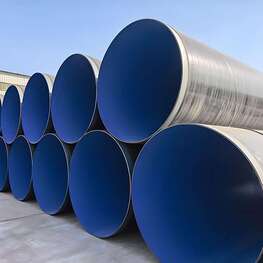
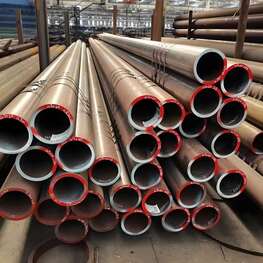
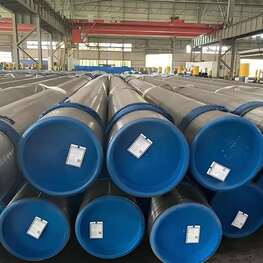
3PE reinforced anti-corrosion steel pipe is a high-performance anti-corrosion pipe product with a three-layer polyethylene (3PE) structure reinforced on the steel pipe surface. It is widely used in oil, natural gas, water supply, and long-distance pipeline projects.
This structure typically consists of three parts:
FBE epoxy powder underlayer (providing excellent adhesion and chemical corrosion resistance)
Adhesive intermediate layer (reinforcing the bond strength between layers)
High-density polyethylene (PE) outer layer (providing mechanical protection, waterproofing, and impact resistance)
Furthermore, "Reinforced" usually refers to improvements made through increased coating thickness, optimized material ratios, or enhanced manufacturing processes, resulting in superior performance in impact resistance, stress cracking resistance, and service life.
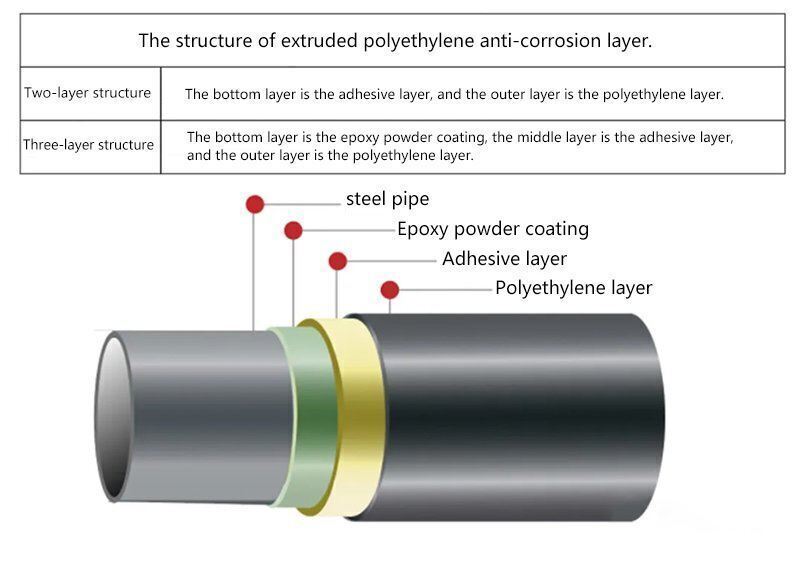
| product name | 3pe anti-corrosion steel pipe |
| first layer | epoxy powder |
| second layer | adhesive |
| third layer | polythene |
| coating film | FBE powder |
| advantage | High-efficiency |
| coating material | FBE/epoxy polyester/paint |
| heating system | electric eurnace equipment |
| cleaning method | vacuum cleaning |
| cooling method | water cooling |
| DN | Polyethylene | Polypropylene |
| ≤ 100 | 2.5mm | 1.8mm |
| > 100 and ≤ 250 | 2.7mm | 2.0mm |
| > 250 and < 500 | 2.9mm | 2.2mm |
| > 500 and < 800 | 3.2mm | 2.5mm |
| > 800 | 3.7mm | 2.5mm |
| Parameter | Specification |
|---|---|
| Steel Pipe Type | Seamless / ERW / LSAW / SSAW |
| Outer Diameter (OD) | 21.3 mm – 3620 mm |
| Wall Thickness (WT) | 2.0 mm – 50 mm |
| Pipe Length | 5.8 m / 6 m / 11.8 m / 12 m or Customized |
| Coating Structure | 3-Layer PE (FBE + Adhesive + PE) |
| Coating Grade | Normal Grade / Reinforced Grade (2LPE / 3PE optional) |
| Total Coating Thickness | 2.5 mm – 4.2 mm (Reinforced Grade) |
| FBE Layer Thickness | ≥ 100 μm |
| Adhesive Layer Thickness | 170 μm – 400 μm |
| PE Layer Thickness | 2.0 mm – 3.7 mm |
| Coating Standard | DIN 30670 / ISO 21809-1 / GB/T 23257 |
| Steel Standards | API 5L / ASTM A53 / ASTM A106 / EN 10217 |
| Steel Grade | GR.B / X42 – X80 / S235 / S355 |
| Working Temperature | -40°C to +80°C |
| Holiday Test Voltage | ≥ 25 kV |
| Adhesion Strength | ≥ 70 N/cm |
| Impact Resistance | ≥ 10 J (no damage) |
| Application | Oil & Gas / Water Supply / Chemical Pipelines |
| Standard No. | Standard Name | Country / Organization | Scope / Description |
|---|---|---|---|
| ISO 21809-1 | Petroleum and natural gas industries — External coatings for buried or submerged pipelines | ISO | Widely used international standard for 3-layer PE coating in oil & gas pipelines |
| DIN 30670 | Polyethylene coatings of steel pipes and fittings | Germany | European standard specifying requirements for 3PE coating systems |
| CSA Z245.21 | Plant-applied external polyethylene coating for steel pipe | Canada | Common in North America for factory-applied PE coatings |
| NACE SP0394 | Application, performance, and quality control of plant-applied coatings | NACE (USA) | Focuses on coating application procedures and quality control |
| API RP 5L2 | Internal Coating of Line Pipe | API (USA) | Related standard used with API 5L pipelines (mainly internal coatings) |
| GB/T 23257 | Steel pipe external polyethylene coating | China | Chinese national standard equivalent to 3PE coating system |
| SY/T 0413 | Technical specification for polyethylene coating of steel pipelines | China (Oil & Gas) | Widely used in oil & gas pipeline engineering projects |
| EN 10288 | Steel tubes and fittings for onshore and offshore pipelines | Europe | Covers external protective coatings, including 3PE systems |
.jpg "3PE Reinforced Anti-corrosion Steel Pipe")
In oil and gas pipeline projects, the selection of 3PE reinforced anti-corrosion steel pipes should not be based solely on specifications or price, but rather on a comprehensive assessment considering the medium, environment, construction conditions, and lifespan requirements. Incorrect selection often leads to anti-corrosion failure, increased maintenance costs, and even pipeline accidents.
| Service Environment | Characteristics | Recommended Selection |
|---|---|---|
| Ordinary soil (farmland, non-contaminated areas) | Low corrosivity | Standard grade 3PE |
| Saline-alkali soil / coastal areas | High salt content, strong electrochemical corrosion | Enhanced grade 3PE (mandatory) |
| Industrial contaminated soil (acidic/alkaline environment) | Severe chemical corrosion | Enhanced grade 3PE + thicker PE layer |
| Subsea pipelines / underwater installation | Long-term immersion | Enhanced grade 3PE + high standards (ISO/DIN) |
Core principle: The harsher the environment, the more necessary it is to choose an enhanced version.
| Conveyed Medium | Operating Conditions | Recommended Steel Grade |
|---|---|---|
| Crude oil transportation | Moderate corrosion | API 5L Gr.B / X42 / X52 |
| Natural gas transportation | High pressure, continuous flow | API 5L X52 / X60 / X65 |
| Long-distance high-pressure transmission | High stress, long service life requirement | API 5L X65 / X70 / X80 |
Key points:
Higher pressure → Requires higher steel grade
Longer distance → Higher steel grade + enhanced corrosion resistance is recommended
| Construction Method | Risk Factors | Recommended Solution |
|---|---|---|
| Open trench burial | General mechanical damage | Standard or enhanced 3PE |
| Pipe jacking / Horizontal Directional Drilling (HDD) | High friction and scratch risk | Enhanced 3PE + thicker coating |
| Rocky terrain sections | High external impact | Enhanced 3PE + ≥3.0 mm PE layer |
| Mountainous / complex terrain | Transport and construction damage risk | Enhanced grade + high adhesion requirement |
| Operating Temperature | Selection Recommendation |
|---|---|
| -20°C to 60°C | Standard 3PE or Enhanced 3PE |
| 60°C to 80°C | Modified 3PE (material verification required) |
| >80°C | ❌ 3PE not recommended; use FBE or 3PP instead |
Important reminder: 3PE is not a panacea; use with caution in high-temperature environments.
| Design Service Life | Recommended Solution |
|---|---|
| 10–20 years | Standard 3PE |
| 20–30 years | Enhanced 3PE |
| 30+ years | Enhanced 3PE + high standards + strict inspection |
International oil and gas projects typically require: ≥25 years of service life → Enhanced grade is mandatory.
International projects: ISO 21809-1
European projects: DIN 30670
Petroleum engineering: NACE / API standards
Selection logic: First consider the environment → then the construction process → then the pressure → then the temperature → finally determine the thickness and standard.
A: The main reason is usually not the material itself, but rather a mismatch between the selected type or the construction method.
Common problems include:
Using "Reinforced Grade 3PE" in highly corrosive environments (such as saline-alkali land or coastal areas) instead of the correct grade.
Inadequate surface treatment (Sa2.5 not met).
Unrepaired mechanical damage during transportation or backfilling.
Solution recommendations:
In projects with high corrosiveness or long service life requirements, 3PE Reinforced Grade must be selected, and construction quality must be strictly controlled.
A: Because ordinary 3PE has insufficient friction resistance.
During HDD construction, the steel pipe will be subjected to:
High friction
Scratching by rocks
Long-distance dragging
Solution recommendations:
Must use:
Reinforced 3PE (thicker PE layer ≥3.0mm)
Or add an outer protective layer (such as a scratch-resistant coating)
A: Because 3PE has an upper temperature limit.
General 3PE application range:
Standard: ≤60℃
Modified: ≤80℃
Above 80℃:
PE layer softens
Adhesive layer performance deteriorates
Risk of peeling occurs
Suggested solution:
For high-temperature applications, use:
FBE (Epoxy Powder)
or 3PP (Polypropylene Anti-corrosion)
A: The core difference lies in "standard implementation + process control," not the material itself.
Key factors affecting lifespan:
Whether ISO 21809-1 / DIN 30670 is followed
Whether the coating thickness meets the standard
Whether the cooling and curing process is stable
Whether 100% spark testing is performed
Recommendation:
When selecting a supplier, focus on:
Test reports
Coating structure parameters
Factory certifications and project case studies
A: Mainly due to insufficient impact resistance design of the outer PE layer or improper packaging.
Common Problems:
Naked packaging, without protective padding.
No protective caps on pipe ends.
Coating cracks caused by stacking and compression.
Solutions:
Use reinforced 3PE (stronger impact resistance).
Strengthen packaging (end caps + shock absorbers + layered support).
A: This is usually due to "unrepaired localized damage + cathodic protection incompatibility".
Typical causes:
Unrepaired scratches during installation
Incompatibility with the cathodic protection system
Improper corrosion protection treatment of weld joints
Solutions:
All damaged areas must be repaired on-site.
Design in conjunction with the cathodic protection system.
Weld joints must use a dedicated joint repair system (Heat Shrink Sleeve, etc.).
 WeChat
 Scan wechat
WhatsApp:+86 15383177997
E-mail:wr@insulatedpipeline.com
E-mail:
Address:Development Zone, Cangzhou, Hebei Province, China
技术支持:沧州利畅网络