EMAIL:
wr@insulatedpipeline.com


Published:2025-09-11 | Last Updated: 2025-09-11 Views: 144
.jpg "Double Layer FBE Coating Pipes")
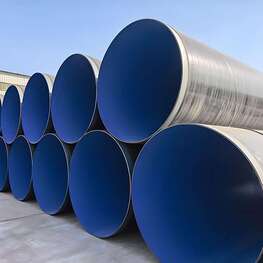
The double-layer FBE-coated pipeline is an anti-corrosion pipeline that features a fusion bonded epoxy powder coating sprayed onto the outer surface of steel pipes. It utilizes steel pipes as the substrate and employs a spraying and curing process to firmly bond the epoxy powder to the surface of the steel pipes. Compared to single-layer FBE coating, the double-layer structure provides superior anti-corrosion performance.
The double-layer FBE coating consists of two parts: the bottom FBE coating and the top FBE coating.
1. Bottom FBE coating
(1) The bottom FBE coating is adhered to the surface of the steel pipe and serves as the core protective layer of the double-layer FBE coated pipeline.
(2) The general thickness ranges from 200 to 300 μm.
(3) After the steel pipe undergoes sandblasting to create a rough surface, the underlying FBE can fully penetrate the uneven surface of the steel pipe, enabling the powder to bond firmly with the steel pipe.
(4) The bottom layer can effectively isolate corrosive media such as moisture, oxygen, and chloride ions.
(5) The bottom FBE coating has good resistance to acid, alkali, and salt solutions, making it suitable for soils and environments with high salt content or strong acidity or alkalinity.
2. FBE coating on the surface layer
(1) The surface layer covers the bottom FBE and its main function is to resist external damage.
(2) Usually 150-250 μ m, customizable according to customer needs.
(3) The surface layer has good wear resistance in backfilling stones, transportation loading and unloading, and pipeline construction.
(4) In low-temperature environments, the surface layer can still maintain toughness, avoiding coating failure due to brittle cracking.
(5) Under the action of cathodic protection current, the surface layer of double-layer FBE can effectively suppress the separation between the coating and the substrate, and maintain the structural stability of the double-layer FBE coated pipeline.
(6) If there are small defects in the local bottom layer, the surface layer can compensate and reduce the risk of corrosion.
3. Double layered synergistic effect
(1) After stacking two layers, the total thickness generally reaches 350-550 μ m.
(2) The surface layer and the bottom layer fuse and solidify at high temperatures, forming a complete coating.
(3) The bottom layer focuses on anti-corrosion, while the surface layer is responsible for mechanical protection;
(4) The two complement each other, enhancing the corrosion resistance and mechanical performance of the pipeline.
Compared to single-layer FBE, the service life of double-layer structure can be extended by 5-10 years in complex environments.
.jpg "Double Layer FBE Coating Pipes")
Incoming inspection → surface pretreatment → cleaning and dust removal → preheating and dew point control → bottom layer FBE electrostatic spraying → bottom layer gel/leveling → surface layer FBE electrostatic spraying → overall curing → cooling → end treatment and groove protection → inspection → identification and packaging
Target thickness: Bottom layer 200-300 μ m, surface layer 150-250 μ m, total thickness 350-550 μ m (actual thickness can be adjusted according to engineering requirements).
| Process | Purpose | Key Equipment / Material | Main Parameters & Control Points (typical range) | Quality Inspection Points | Common Defects & Prevention |
|---|---|---|---|---|---|
| Incoming inspection | Verify base pipe quality & dimensions | UT / MPI; calipers, thickness gauge | Steel grade, ovality, end face; weld appearance | Record batch & traceability code | Rust on incoming pipe: grade & isolate, process first |
| Surface preparation (blasting) | Remove rust, increase roughness, improve adhesion | Shot-blast / blast room; steel shot / grit | Cleanliness Sa 2½–Sa 3 (ISO 8501-1); roughness Rz 40–100 µm; surface oil- & dust-free | Visual cleanliness; roughness comparator / stylus | Insufficient cleanliness → adjust blast flow & angle; oil → alkaline wash / solvent wipe |
| Cleaning & dust removal | Remove loose dust & residues | Vacuum, air knife, tack rolls | No visible dust; low salt contamination | Chloride test paper / sampling (≤ 20 mg/m²) | Dust residue → increase vacuum airflow & blow-off |
| Pre-heating & dew-point control | Provide fusion condition, avoid condensation | Medium-frequency inductor / gas oven | Pipe surface 200–250 °C (per powder TDS); ≥ dew-point +3 °C; ΔT ≤ ±5 °C | IR pyrometer; dew-point meter; log curve | Low temperature → adjust line speed / power; condensation → heat & raise dry-air flow |
| Primer FBE electrostatic spray | Form first anti-corrosion layer | Electrostatic guns; primer FBE powder | Multi-peak size (D50 30–80 µm); gun pressure & voltage per TDS; target 200–300 µm; even coat | Wet / cured thickness; no step at overlap | Uneven thickness → optimize gun distance / path; pinholes → raise pre-heat & powder feed |
| Primer gel / flow (window) | Bring primer to “bite” state | Residual heat / short oven zone | Gel time 10–30 s @ 200–230 °C (system dependent); slight gloss, tack-free | Touch / temp-crayon; microtome sample | Over-gel → poor top-coat fusion; under-gel → inter-layer bubbles |
| Topcoat FBE electrostatic spray | Improve abrasion, impact & cathodic disbondment resistance | Electrostatic guns; topcoat FBE powder | Spray within primer gel window; 150–250 µm; fuse with primer | Total cured thickness 350–550 µm | Orange-peel / sag → tune powder output & steel temp |
| Full cure | Complete cross-linking, achieve properties | Cure oven / tunnel | Steel surface 200–230 °C hold 2–5 min (formula & thickness dependent); uniform | ΔTc curve / hardness check; scratch / impact pre-test | Under-cure → poor chemical / adhesion; over-bake → embrittlement, colour change |
| Cooling (air / mist) | Stabilise, ready for handling | Air blow / water mist | Cool to <60 °C before stacking; avoid thermal shock | Temp check; visual re-inspection | Water stain → optimise droplet size & angle |
| End finishing & bevel protection | Facilitate welding & field joint | Strip coating, end caps | Leave un-coated 60–150 mm (per spec); snug cap | End dimension / cleanliness | Too short → welding interference; too long → field joint repair needed |
| Thickness inspection | Verify coating meets spec | Magnetic / eddy-current gauge | Multiple circumferential & axial points; record primer, top & total | Submit thickness map | Single spot thick / thin → trace & re-spray |
| Holiday (spark) test | Detect through-pinholes | DC high-voltage detector | Voltage per standard / curve (FBE 6–12 kV typical); full scan | Mark & patch defects | Miss → excessive speed; false → high voltage / damp |
| Adhesion / impact | Evaluate bond & impact resistance | Pull-off / cross-cut; impact tester | Adhesion ≥8–12 MPa (or 0/1 cross-cut); impact ≥8–10 J (no crack, no loss) | Issue test report | Poor bonding → inadequate prep & dew-point control |
| Cathodic disbondment (type / spot) | Assess stability under CP | CD test cell | e.g. 65 °C / 1.5 V / 48–168 h; disbondment radius per spec | Measure disbondment radius | Excessive → under-cure / powder mismatch |
| Marking & packaging | Traceability & damage prevention | Stencil, dunnage, strapping | Mark (grade / coating / batch / date); impact protection | Final inspection sheet | Transit damage → optimise dunnage / spacer |
1. International commonly used standards
(1) ISO 21809 series (External anti-corrosion coatings for pipelines used in the petroleum and natural gas industry)
ISO 21809-2: Suitable for fusion bonded epoxy powder (FBE) coatings and double-layer/three-layer structures.
Clearly defined performance indicators such as coating thickness, adhesion, cathodic peel resistance, impact resistance, and wear resistance.
(2) AWWA C213 (American Water Conservancy Association Standard)
《Fusion-Bonded Epoxy Coatings for Steel Water Pipe and Fittings》
FBE coating for water supply pipelines, covering single-layer and double-layer structures.
(3) CSA Z245.20 (Canadian Standards Institute)
《Fusion Bond Epoxy Coating for Steel Pipe》
Suitable for anti-corrosion coatings on oil, gas, and buried steel pipes, widely used in North America.
(4) API RP 5L9 (Recommended Practice of the American Petroleum Institute)
《External Fusion Bonded Epoxy Coating of Line Pipe》
Guide the construction and testing of external anti-corrosion coatings for long-distance oil and gas pipelines.
2. Domestic commonly used standards
(1)SY/T 0315-2013
Technical standard for epoxy powder coating of buried steel pipelines
The Chinese petroleum and natural gas industry standards have clear requirements for the performance indicators of FBE and double-layer FBE.
(2)GB/T 23257-2017
Technical standard for polyethylene layer and fusion bonded epoxy powder coating of buried steel pipelines
Suitable for buried pipelines of oil, natural gas, and water supply and drainage, covering FBE single-layer, double-layer, and three-layer.
(3)CJ/T 120-2016
Technical Standard for External Coating of Water Supply Steel Pipes
Regarding the municipal water supply field, it involves requirements for FBE and its composite coatings.
3. Main technical requirements (general indicator range)
| Item | Required Value (common range) |
|---|---|
| Total coating thickness | 350–550 µm |
| Adhesion | ≥ 30 N/cm² |
| Cathodic disbondment | ≤ 8 mm @ 65 °C, 48 h |
| Impact strength | ≥ 3 J/mm |
| Water absorption | ≤ 0.5 % |
| Continuous temperature resistance | –30 °C to +100 °C |
| Electrical resistivity | ≥ 1 × 10¹² Ω·cm |
4. Comparison Table of Double Layer FBE Coating Pipeline Standards
| Standard category | Standard No. / Title | Scope of application | Main technical requirements (typical range) |
|---|---|---|---|
| International | ISO 21809-2 Petroleum and natural gas industries — External coatings for buried or submerged pipelines — Fusion-bonded epoxy coatings | External anti-corrosion coatings (single-/dual-layer FBE, three-layer PE, etc.) for long-distance oil & gas pipelines | Thickness: 350–550 µm; cathodic disbondment ≤ 8 mm / 65 °C / 48 h; adhesion ≥ 30 N/cm²; impact strength ≥ 3 J/mm |
| AWWA C213 Fusion-Bonded Epoxy Coatings for Steel Water Pipe and Fittings | Municipal water-supply pipes and fittings | Thickness: ≥ 350 µm; good water resistance; electrical resistivity ≥ 1 × 10¹² Ω·cm; temperature –30 °C to +95 °C | |
| CSA Z245.20 Fusion Bond Epoxy Coating for Steel Pipe | Oil & gas transmission pipelines in Canada | Thickness: 300–500 µm; excellent abrasion resistance; cathodic disbondment ≤ 8 mm / 65 °C / 48 h; continuous service +110 °C | |
| API RP 5L9 External Fusion Bonded Epoxy Coating of Line Pipe | Oil & gas transmission pipelines | Specifies surface preparation, spray procedure, inspection methods; thickness usually ≥ 350 µm; adhesion ≥ 30 N/cm² | |
| National (China) | SY/T 0315-2013 Technical standard for external fusion-bonded epoxy powder coating of buried steel pipelines | Domestic oil & gas transmission pipelines | Thickness: 350–500 µm; adhesion ≥ 30 N/cm²; cathodic disbondment ≤ 8 mm; impact ≥ 3 J/mm; water absorption ≤ 0.5 % |
| GB/T 23257-2017 Technical standard for polyethylene layer and fusion-bonded epoxy powder external coating of buried steel pipelines | Buried oil-, gas- and water-supply pipelines | Thickness: 350–550 µm; temperature –30 °C to +100 °C; electrical resistivity ≥ 1 × 10¹² Ω·cm; cathodic disbondment ≤ 8 mm | |
| CJ/T 120-2016 Technical standard for external coating of steel water pipes | Municipal water-supply pipelines | Thickness ≥ 300 µm; hydrolysis resistant; high electrical insulation; suitable for buried and wet environments |
Summary:
International standards (ISO, API, CSA, AWWA) focus more on long-distance oil and gas pipelines and drinking water pipelines, emphasizing global universality and reliability.
Domestic standards (SY/T, GB/T, CJ/T) are more in line with the needs of the Chinese market and are suitable for various scenarios such as oil and gas engineering and municipal engineering.
| Category | Test item | Main content / Acceptance criterion |
|---|---|---|
| Visual & Basic | Visual inspection | Smooth, free of pinholes, cracks, bubbles, delamination |
| Thickness test | Total thickness 350–550 µm | |
| Holiday test | Spark test at 5–15 kV | |
| Physical & Mechanical | Adhesion test | ≥ 30 N/cm² |
| Impact test | ≥ 3 J/mm | |
| Bend test | No cracks or loss after bending | |
| Abrasion test | No obvious damage after abrasion | |
| Corrosion & Durability | Cathodic disbondment test | ≤ 8 mm (65 °C, 48 h) |
| Water-absorption test | ≤ 0.5 % | |
| Chemical-resistance test | Resistant to acid, alkali and salt | |
| Temperature-resistance test | −30 °C to +100 °C | |
| Electrical | Insulation-resistance test | ≥ 1 × 10¹² Ω·cm |
.jpg "Double Layer FBE Coating Pipes")
| Coating type | Structural features | Corrosion protection | Mechanical properties | Temperature resistance | Cost level | Typical applications |
|---|---|---|---|---|---|---|
| Single-layer FBE | One layer of epoxy powder, 200–400 µm | Good corrosion resistance, moderate mechanical-damage resistance | Relatively low impact & abrasion resistance | −30 °C to +95 °C | Medium | Small- & medium-diameter buried lines for gas & water |
| Dual-layer FBE | Primer for corrosion + topcoat for reinforcement, 350–550 µm | Excellent corrosion & cathodic-disbondment resistance | Better impact & wear resistance than single-layer FBE | −30 °C to +100 °C (some specs +110 °C) | Medium-high | Oil-gas transmission, municipal water, long-distance buried pipelines |
| 3PE | FBE primer + adhesive + polyethylene | Superior corrosion protection, strong barrier | High mechanical strength, scratch & impact resistant | −30 °C to +80 °C | High | Large-diameter oil-gas trunk lines, aggressive buried environments |
| 3PP | FBE primer + adhesive + polypropylene | Excellent corrosion & mechanical performance | Outstanding high-temperature impact & abrasion resistance | −30 °C to +120 °C | Higher | High-temperature oil-gas lines, offshore pipelines, severely corrosive areas |
 WeChat
 Scan wechat
WhatsApp:+86 15383177997
E-mail:wr@insulatedpipeline.com
E-mail:
Address:Development Zone, Cangzhou, Hebei Province, China
技术支持:沧州利畅网络

.jpg)
.jpg)