EMAIL:
wr@insulatedpipeline.com


Published:2025-09-22 | Last Updated: 2025-09-22 Views: 134
.jpg)
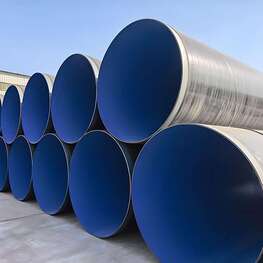
FBE Coated Seamless Pipes are high-performance corrosion-resistant pipelines featuring a fusion-bonded epoxy (FBE) powder coating applied to the surface of seamless steel tubes. As municipal, petroleum, natural gas, and industrial pipeline systems demand increasingly robust corrosion resistance and protective performance, FBE-coated seamless pipes have emerged as the material of choice for modern pipeline engineering due to their exceptional properties.
(1) Superior Corrosion Resistance — Reduced Pipeline Maintenance Costs
The FBE coating forms a uniform, dense protective layer that effectively prevents corrosion from water, sewage, acidic/alkaline liquids, and seawater.
Function: In municipal water supply pipelines or chemical networks, using FBE-coated seamless pipes reduces leaks or pipe replacements caused by internal corrosion, lowering long-term maintenance costs.
(2) Strong Adhesion and Mechanical Protection — Prevents Construction Damage
After fusion curing, the FBE coating bonds tightly to the steel pipe, resisting peeling or cracking while withstanding minor impacts during handling and construction.
Effect: During on-site pipe handling or welding, there is no risk of coating detachment, reducing the need for recoating or rework due to construction damage and improving construction efficiency.
(3) Streamlined Installation — Shortened Project Timelines
FBE-coated pipes arrive as finished products requiring no secondary on-site coating. They are ready for direct installation and compatible with flange, threaded, socket weld, and other jointing methods.
Effect: For municipal or industrial pipeline projects, this significantly shortens construction cycles while reducing reliance on specific anti-corrosion conditions at the site, lowering both installation complexity and costs.
(4) Adaptability to Diverse Conditions — Resolving Selection Challenges
FBE-coated seamless pipes suit underground burial, humid, chemical corrosion, or marine environments, operating within -20°C to 80°C and pressures up to 5.0 MPa.
Function: Designers can select appropriate FBE pipes based on pipeline media and pressure requirements without concerns about premature aging due to environmental corrosion, ensuring long-term safe operation of pipeline networks.
(5) Extended System Lifespan — Long-Term Economic Benefits
FBE coating corrosion protection extends pipeline service life by several times.
Function: For investors, slightly higher initial costs are offset by reduced long-term maintenance, minimized pipeline renovation and shutdown risks, and enhanced project return on investment.
.jpg)
| Parameter Name | Typical Value / Range |
|---|---|
| Outer Diameter (OD) | 20–1200 mm |
| Wall Thickness (WT) | 3–25 mm |
| Length | 6 m / 12 m standard lengths |
| Material | Carbon steel (Q235B, ASTM A53, ASTM A106) |
| Internal Coating Thickness | 150–300 μm |
| External Coating Thickness | 150–500 μm |
| Operating Temperature | -20 ℃ ~ 80 ℃ |
| Operating Pressure | ≤ 5.0 MPa |
| Coating Adhesion | ≥ 15 MPa |
| End Connection | Flanged, Threaded, Socket-weld |
Note: Parameters can be customized according to project requirements to ensure safe and reliable pipeline operation under various conditions.
(1) Underground Buried Environments
Applications: Municipal water supply networks, long-distance oil and gas pipelines, industrial circulating water pipelines.
Reasons for Suitability: FBE coating effectively resists corrosion from soil moisture, salts, and microorganisms, ensuring long-term safe operation of buried pipelines.
(2) Damp and High-Humidity Environments
Applications: Sewage treatment plant networks, cooling water systems, coastal water supply pipelines.
Reason for Suitability: The dense, pinhole-free coating resists moisture penetration, preventing pipeline corrosion.
(3) Marine and Salt-Spray Environments
Applications: Port facilities, subsea oil and gas pipelines, coastal industrial zone networks.
Reason for Suitability: FBE coating exhibits excellent salt spray resistance, preventing chloride ion corrosion and extending pipeline lifespan.
(4) Petroleum and Natural Gas Transmission Environments
Typical Applications: Crude oil pipelines, natural gas pipelines, refinery supporting pipeline networks.
Reason for Suitability: FBE coating resists chemical corrosion and withstands pressure and complex conditions during petroleum and natural gas transmission.
(5) Industrial and Municipal Ambient Temperature Media Environments
Applications: Water supply pipelines, industrial circulating water systems, general acid/alkali wastewater conveyance.
Reasons for Suitability: The smooth coating reduces medium resistance, offers superior corrosion resistance, low maintenance costs, and is suitable for long-term stable operation.
FBE-coated seamless pipes are primarily suitable for ambient, low-to-medium temperature, corrosive media, and underground or humid environments. They are particularly well-suited for municipal, petroleum/natural gas, and industrial pipeline systems with high requirements for corrosion resistance and service life.
.jpg)
| Service Category | Specific Condition | Applicability | Remarks |
|---|---|---|---|
| Operating Temperature | -30 ℃ – +80 ℃ ambient transport | Applicable | FBE remains stable and offers excellent corrosion protection within this range. |
| +80 ℃ – +120 ℃ medium-high temperature transport | Conditional | High-temperature-resistant modified FBE required; suitable for some oil & gas lines. | |
| ≥120 ℃ steam, hot water, high-temperature duties | Not applicable | Coating softens and fails; use insulated high-temperature pipe or alternative materials. | |
| Transport Medium | Clean water, potable water, domestic water | Applicable | Non-toxic, hygienic, long-lasting. |
| Sewage, industrial wastewater | Applicable | Resists chemical attack; ideal for municipal & industrial drainage. | |
| Crude oil, natural gas | Applicable | Most common application; FBE prevents soil & internal corrosion. | |
| Acid, alkali, salt solutions | Conditional | Tolerates limited concentrations; high concentrations need special lining or coating. | |
| High-temperature steam, district heating | Not applicable | FBE is unsuitable for hot, wet environments; choose pre-insulated composite pipe. | |
| Service Environment | Buried underground pipelines | Applicable | Superior soil-side corrosion resistance; widely used for long-distance transmission. |
| Humid, salt-fog or marine atmospheres | Applicable | Strong salt-spray resistance; suitable for harbour and subsea lines. | |
| Frigid, cold regions | Applicable | Good low-temperature flexibility; coating will not crack. | |
| High-temperature plant areas, direct-buried heating lines from boiler houses | Not applicable | Coating performance degrades under sustained high heat. |
.jpg)
(1) How can scratches or impact damage to the FBE coating be avoided during transportation or installation?
Answer: Use soft slings for lifting and install protective caps on pipe ends to prevent direct friction with hard objects. If damage occurs, promptly repair the ends and affected areas.
(2) Will the FBE coating bubble or peel if the transport temperature approaches or exceeds 80°C?
Answer: The FBE coating is generally suitable for temperatures between -20°C and 80°C. Prolonged high temperatures may reduce adhesion. For high-temperature transport, insulated pipes or other high-temperature resistant anti-corrosion coatings should be selected.
(3) How should corrosion protection be handled at pipe weld joints to prevent them from becoming corrosion weak points?
Answer: Use heat-shrinkable tape or specialized epoxy coatings for joint sealing. Ensure the seal thickness matches the original pipe material, achieving complete coverage without pinholes or gaps.
(4) Does the presence of pinholes or peeling in the coating indicate inadequate adhesion or quality?
Answer: Yes. Pinholes or peeling are often related to coating application issues or insufficient inspection. Request inspection reports during procurement and conduct on-site spot checks of coating thickness and adhesion.
(5) Can FBE-coated seamless pipes withstand long-term use in high-salinity, strong acid/alkali environments, or soils with inadequate cathodic protection?
Answer: Standard FBE coatings struggle to endure extreme conditions over extended periods. Opt for enhanced-grade FBE or composite coatings (e.g., FBE+PE) alongside a cathodic protection system.
 WeChat
 Scan wechat
WhatsApp:+86 15383177997
E-mail:wr@insulatedpipeline.com
E-mail:
Address:Development Zone, Cangzhou, Hebei Province, China
技术支持:沧州利畅网络

.jpg)
.jpg)