
EMAIL:
wr@insulatedpipeline.com



Number of visits:23 seconds Update time:2026-06-04
As a key structural material used in high-pressure pipeline systems, bridge piling projects, and thermal energy transmission networks, Spiral Steel Pipe (SSAW) plays a critical role in determining the safety, durability, and service life of major engineering projects. For buyers, establishing a systematic, checklist-based quality inspection process is not only essential for identifying defective products before shipment, but also a powerful tool for supplier control and quality assurance negotiation.
The following is a comprehensive, practical, and field-applicable pre-shipment inspection checklist for SSAW steel pipes:
High-quality steel pipes begin with high-quality steel coils (strip plate). Before shipment, all source documentation must be verified to ensure full traceability and authenticity.
1. Mill Test Certificate (MTC) Verification
Verify that the heat number and coil number of each steel pipe match the original Mill Test Certificate issued by the steel mill. Key checks include chemical composition (especially harmful elements such as Sulfur (S) and Phosphorus (P)) and mechanical properties (yield strength, tensile strength, and elongation), ensuring full compliance with the contractually specified standard such as GB/T 9711, API 5L, or SY/T 5037.
2. Welding Consumables Certification Review
SSAW steel pipes are manufactured using double-sided submerged arc welding (DSAW). It is essential to confirm that welding wire and flux materials are accompanied by valid certificates and are fully compatible with the base material strength. The use of substandard or mismatched welding consumables must be strictly prohibited.
Dimensional deviation and surface defects can directly cause field assembly failure or reduce structural pressure capacity. Inspection should be performed using calibrated measuring tools on a full or sampling basis.
1. Wall Thickness & Negative Tolerance Verification
Measure wall thickness using a micrometer or ultrasonic thickness gauge at both ends and the mid-section of each pipe. The key focus is whether the thickness falls within the allowable tolerance range. For pipes manufactured under GB/T 9711, negative tolerance control is significantly stricter than SY/T 5037 standards.
2. Outer Diameter, Ovality & Straightness Measurement
Outer diameter can be calculated from circumference using a tape measure, while calipers should be used to check ovality (difference between maximum and minimum diameter at the same cross-section). Excessive ovality may lead to misalignment during field welding. Straightness must also be verified; typically, deviation should be less than 1.5 mm per meter, and total bending should not exceed 0.1% of the overall pipe length.
3. Weld Reinforcement Height & Misalignment Check
Use a weld gauge to measure internal and external weld reinforcement height, typically required to be within 0.5 mm–3.0 mm. Excessive reinforcement may affect coating application. Weld misalignment must also be checked, as it is one of the primary causes of crack initiation.
4. Pipe End Bevel & Surface Defect Inspection
Confirm that bevel angle (typically 30°–35°) and root face are properly machined. The pipe surface and weld seam must be free from cracks, lack of fusion, slag inclusions, porosity, burn-through, or severe mechanical damage. Weld spatter must be thoroughly removed.
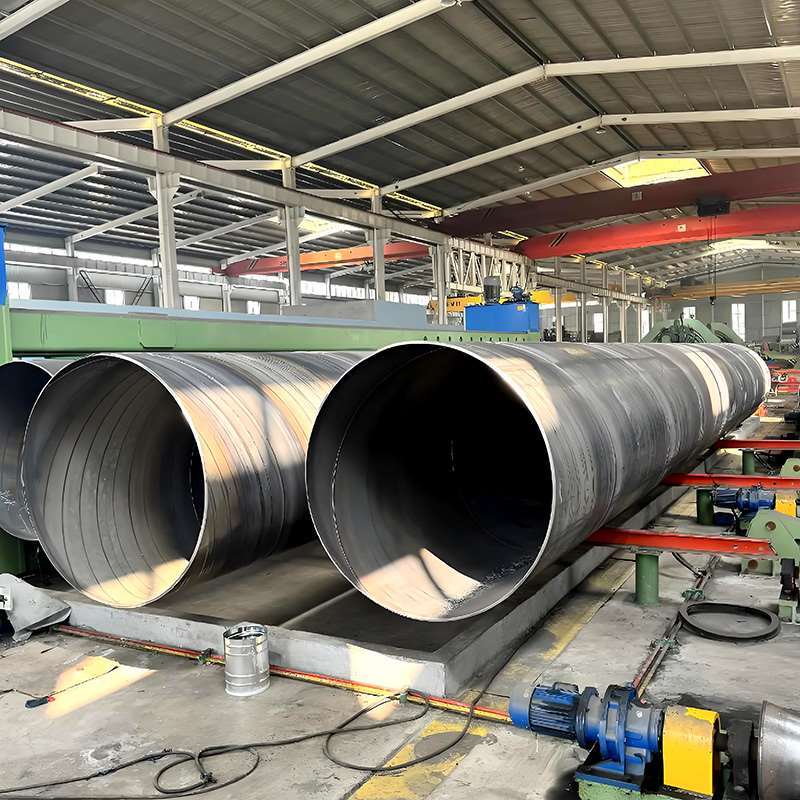
Before leaving the factory, SSAW steel pipes must undergo strict hydrostatic testing to eliminate risks of leakage and burst failure in service.
1. 100% Hydrostatic Test Verification (Pipe-by-Pipe)
This is a mandatory inspection for every single pipe. Review or supervise hydrostatic test records, focusing on:
Test Pressure: Must meet or exceed the design or standard-required pressure, typically calculated using P = 2St/D, and not less than 1.5 times the working pressure.
Holding Time: Minimum 5 seconds for general fluid pipes; at least 10 seconds for high-pressure pipelines (e.g., GB/T 9711).
Acceptance Criteria: No pressure drop during holding time, and no leakage or deformation on pipe body or weld seam. Digital pressure curve records from automated testing systems should be provided by the manufacturer.
Visual inspection cannot reveal internal weld defects. NDT methods are essential for detecting micro-cracks, porosity, and other critical internal flaws.
| NDT Method | Key Verification Points | Application & Acceptance Standard |
|---|---|---|
| Ultrasonic Testing (UT) | Is 100% full-length weld coverage ensured? Is equipment within calibration validity? | Primary in-line inspection method. API 5L / GB/T 9711 requires 100% full-length UT inspection. |
| Radiographic Testing (RT) | Are pipe ends, UT suspicious areas, and T-joints re-tested? Are films or digital images archived? | Qualitative verification. Typically mandatory within 200 mm of pipe ends. |
| Magnetic Particle / Penetrant Testing (MT/PT) | Are bevel areas and repaired welds surface-inspected? | Used to detect surface cracks or lamination defects at pipe ends. |
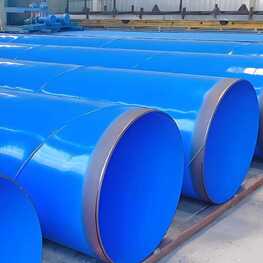
For coated or insulated SSAW pipes (e.g., 3PE, coal tar epoxy, or polyurethane insulated pipes), specialized inspection is required before shipment.
Coating Thickness & Holiday Detection
Use a coating thickness gauge to verify whether anti-corrosion layers (such as 3PE or epoxy coating) meet design requirements for standard or reinforced grades. Perform full-surface holiday detection using an electric spark tester (e.g., 25 kV probe for 3PE systems) to ensure 100% absence of pinholes or coating defects.
Insulation Density, Thickness & Concentricity
For polyurethane pre-insulated pipes, confirm uniform foam density and insulation thickness. Check that the outer HDPE casing is undamaged and that concentricity between the steel pipe and outer casing meets specification requirements to avoid eccentricity-related heat loss during installation.
Marking & Identification Verification
Each pipe must have clear, durable markings including: manufacturer name, standard, steel grade, specification (OD × WT), length, heat number, production date, and “Qualified” status.
Pipe End Protection & Lifting Inspection
Verify whether plastic end caps or protective rings are installed to prevent deformation during transportation and lifting. Also ensure that slings or steel cables used for bundling will not damage the pipe surface or anti-corrosion coating.
 WeChat
 Scan wechat
WhatsApp:+86 15383177997
E-mail:wr@insulatedpipeline.com
E-mail:
Address:Development Zone, Cangzhou, Hebei Province, China
技术支持:沧州利畅网络

.jpg)