EMAIL:
wr@insulatedpipeline.com


Published:2025-08-21 | Last Updated: 2025-09-09 Views: 178
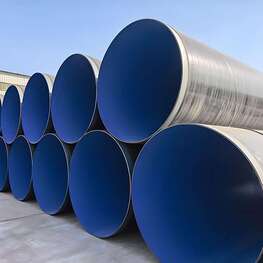
FBE coated pipe refers to seamless carbon steel pipes with a fusion-bonded epoxy powder coating (Fusion Bonded Epoxy) applied to their outer surfaces.
This coating is formed by melting the epoxy powder at high temperatures and bonding it firmly to the seamless steel pipe surface, creating a corrosion-resistant protective layer.
The coating combines excellent corrosion resistance with mechanical properties, making it widely used in pipeline systems for transporting oil, natural gas, water, and other corrosive media.
FBE coating, with its environmentally friendly, solvent-free properties, mature construction process, strong adhesion, and excellent corrosion resistance, has become the mainstream choice for modern pipeline corrosion protection.
.jpg "fbe coated pipe")
| Component | Description | Function & Characteristics |
|---|---|---|
| Carbon steel welded pipe Substrate | Carbon steel pipe meeting standards such as API 5L and GB/T 9711, with dimensions and mechanical properties satisfying design requirements. | Provides structural strength and pressure-bearing capacity; forms the main body of the pipeline. |
| Surface Blasting Treatment | Steel grit or shot blasting to SA 2.5 grade, removing rust, mill scale, oil and grease; surface roughness Ra 2.5–4.0 µm. | Enhances mechanical interlocking and adhesion between coating and steel, ensuring a uniform and firmly bonded coating that resists peeling and blistering. |
| Fusion-Bonded Epoxy (FBE) Coating | Powder coating based on epoxy resin, fused at high temperature to form a dense, uniform protective film, typically 150–300 µm thick. | Delivers excellent corrosion protection, resists chemical attack and moisture, effectively isolates the steel from corrosive media, and extends pipeline service life. |
(1) Excellent corrosion resistance
FBE coated steel pipes have a high density and excellent chemical corrosion resistance. They can effectively block moisture and oxygen, preventing the steel pipes from rusting. Compared with traditional epoxy asphalt and polyethylene coatings, it has better corrosion resistance and is widely used in various corrosive media and complex soil environments. This is a major advantage of fusion bonded epoxy coating steel pipes in long-term buried pipelines.
(2) Excellent adhesion and wear resistance
Through strict surface treatment and high-temperature welding processes, the FBE coated pipe is closely bonded to the surface of the steel pipe, forming a firm protective layer. It not only has excellent adhesion, but also can effectively resist mechanical damage caused during transportation, hoisting and construction. This also applies to coated steel pipes that have high requirements for wear resistance and adhesion.
(3) Environmentally friendly, solvent-free, and safe for construction
FBE powder coatings contain no solvents or harmful volatile organic compounds (VOCs), and are pollution-free during the application process, meeting modern environmental protection and occupational safety standards. This green characteristic makes FBE coated steel pipes widely used in petroleum, natural gas and water supply and drainage projects.
(4) Moderate heat resistance
FBE coating is usually suitable for pipeline systems where the working temperature does not exceed 120℃. If the project is in a high-temperature environment, a double-layer structure or combination with other coatings can be selected to enhance the temperature resistance performance. In some applications that require resistance to high pressure and high temperature, common seamless steel pipes are also used in combination with FBE coatings.
(5) Good impact resistance and fatigue resistance
Fusion-bonded epoxy coatings have a certain degree of flexibility and can withstand the impact and vibration generated by pipelines during transportation, construction and long-term operation, ensuring the stability and service life of the overall structure.
| Item | Specific Requirements | Reference Standards & Notes |
|---|---|---|
| Coating Thickness | Single-layer FBE coating 150–300 µm, finalized according to the pipeline environment; coating shall be uniform and free of visible defects. | GB/T 19250-2013; API RP 5L2; NACE Standards |
| Adhesion | ≥ 10 MPa (pull-off or cross-cut test); coating firmly bonded to the steel substrate, no peeling or delamination. | GB/T 19250; ASTM D4541 |
| Impact Resistance | Coating withstands bending and impact tests (e.g., 180° bend without cracking); no cracking or detachment. | GB/T 19250; NACE RP0394 |
| Corrosion Resistance | Passes salt-spray test (≥ 500 h without rusting) and cyclic humidity test; no blistering, cracking, or peeling. | ASTM B117 (salt-spray); ISO 12944 |
| Temperature Resistance | Service temperature normally ≤ 120 °C; for special applications, dual-layer FBE or combined systems may be used. | API RP 5L2; project-specific requirements |
| Surface Preparation Quality | Steel surface blast-cleaned to Sa 2½, roughness Ra 2.5–4.0 µm, free of oil, grease, and rust. | ISO 8501-1; NACE No. 2 |
| Coating Uniformity & Appearance | Smooth and uniform finish; no bubbles, pinholes, runs, cracks; consistent color. | GB/T 19250; visual inspection standards |
| Thickness Measurement Method | Dry-film gauge or ultrasonic thickness gauge; multiple-point measurement averaged to verify compliance with design thickness. | ASTM D7091; ISO 2808 |
| Environmental & Safety Requirements | Construction and products shall be solvent-free and compliant with VOC emission limits; safe work practices enforced. | EU VOC Directive; OSHA safety standards |
| Mechanical Property Requirements | Steel pipe mechanical properties shall meet relevant standards: tensile strength, yield strength, impact toughness, etc. | API 5L; GB/T 9711 |
(1) Preparation of steel pipes
Original pipe selection: Seamless steel pipes welded steel pipes or straight seam submerged arc welded steel pipes can be used as base materials. Different types of base pipes should be selected according to the project requirements.
Preliminary inspection: Inspect the appearance of the steel pipe, remove oil stains, soil and welding slag, and ensure that there are no obvious defects on the surface.
(2) Surface pretreatment
Sandblasting/shot blasting treatment: The outer wall of the steel pipe is treated to have a metallic luster, and the roughness reaches above Sa2.5 grade.
Dust removal: Use compressed air or a dust suction device to clean the floating dust to ensure the surface is clean, laying a solid foundation for the subsequent process of fusing epoxy coating or plastic-coated steel pipe.
(3) Heat the steel pipe
Heat the steel pipe to a temperature range of 180℃ to 250℃ to ensure that the subsequent powder can be fully melted.
The temperature control must be precise. If it is too high, it will affect the performance of the coating; if it is too low, the powder will not be able to melt.
(4) Fusion-bonded epoxy powder coating
Electrostatic spraying: Use an electrostatic spray gun to evenly spray epoxy powder onto the surface of the heated steel pipe.
Melt leveling: The powder rapidly melts and levels at high temperatures, forming a dense coating with the steel pipe.
(5) Curing and film formation
The coating is firmly bonded to the surface of the steel pipe, forming a highly adhesive anti-corrosion protective layer.
The coating thickness is generally between 250μm and 500μm and can be adjusted according to the engineering requirements.
(6) Cooling and setting
Natural cooling or water cooling enables the coating to cure quickly and prevent cracking.
Ensure that the coating is uniform and dense, with a smooth surface free of pinholes.
| Nominal Diameter DN (mm) | Inch | Outside Diameter OD (mm) | Wall Thickness WT (mm) | Theoretical Weight (kg/m) | Remarks |
|---|---|---|---|---|---|
| 15 | 1/2" | 21.3 | 2.0 | 1.12 | Small bore |
| 20 | 3/4" | 26.9 | 2.3 | 1.65 | Small bore |
| 25 | 1" | 33.7 | 3.1 | 2.37 | Small bore |
| 32 | 1-1/4" | 42.4 | 3.1 | 3.13 | Small bore |
| 40 | 1-1/2" | 48.3 | 3.0 | 4.15 | Small bore |
| 50 | 2" | 60.3 | 3.0 | 5.11 | Small bore |
| 65 | 2-1/2" | 76.1 | 3.6 | 7.57 | Medium bore |
| 80 | 3" | 88.9 | 3.6 | 8.88 | Medium bore |
| 100 | 4" | 114.3 | 4.0 | 12.2 | Medium bore |
| 125 | 5" | 139.7 | 4.5 | 17.0 | Medium bore |
| 150 | 6" | 168.3 | 4.5 | 20.7 | Medium bore |
| 200 | 8" | 219.1 | 5.0 | 29.0 | Medium bore |
| 250 | 10" | 273.0 | 6.0 | 42.5 | Medium bore |
| 300 | 12" | 323.9 | 7.0 | 57.5 | Large bore |
| 350 | 14" | 355.6 | 7.0 | 63.2 | Large bore |
| 400 | 16" | 406.4 | 8.0 | 81.4 | Large bore |
| 450 | 18" | 457.0 | 8.0 | 91.5 | Large bore |
| 500 | 20" | 508.0 | 9.0 | 114.3 | Large bore |
| 600 | 24" | 609.6 | 10.0 | 146.0 | Large bore |
| 700 | 28" | 711.0 | 11.0 | 185.0 | Extra-large bore |
| 800 | 32" | 813.0 | 12.0 | 230.0 | Extra-large bore |
| 900 | 36" | 914.0 | 13.0 | 280.0 | Extra-large bore |
| 1000 | 40" | 1016.0 | 14.0 | 340.0 | Extra-large bore |
| 1200 | 48" | 1219.0 | 16.0 | 460.0 | Extra-large bore |
i. Identify the project operating conditions.
Transport media: Water, hot water, steam, chemicals, etc. Different media have different requirements for pipe materials and corrosion resistance.
Operating temperature: FBE-coated pipe is suitable for ambient to moderate temperatures (≤150°C). For high temperatures or highly corrosive media, double-layer FBE or 3PE can be used.
Operating pressure: Select the pipe wall thickness (Schedule/Thickness Series) based on the design pressure to ensure safe operation.
Note: For mildly corrosive environments plastic-coated carbon steel pipe or plastic-coated steel pipe can be considered for both economical and safety reasons.
ii. Determine Pipeline Diameter and Length
Nominal Diameter (DN): Select based on flow requirements and pipeline layout.
Pipeline Length: For long-distance transmission, consider transportation and construction convenience, as well as the impact of the number of joints on costs.
iii. Select an Outside Diameter System (A/B System)
System A: Standardized, common nominal dimensions, easy to install and interface with.
System B: Suitable for special designs or retrofit projects, meeting both pressure and wall thickness requirements.
When purchasing a project, the system should be selected based on the construction conditions and interface equipment.
iv. Determine Wall Thickness and Corrosion Protection Type
Wall Thickness Selection: Choose Schedule 40, 80, 120, or custom thickness based on design pressure, burial depth, and mechanical load.
Corrosion Protection Type:
Single-layer FBE (Fusion Bonded Epoxy Coated Steel Pipe): Provides standard corrosion protection, suitable for underground or water pipelines.
Double-layer FBE: Suitable for slightly more corrosive environments, offering a longer service life.
3PE (Triple Polyethylene Coating): Suitable for highly corrosive environments or seawater pipelines.
For mildly corrosive environments, plastic-coated or plastic-coated steel pipes are also economical and reliable options.
v. Consider the construction and installation environment.
Direct underground burial: Choose pipes that are resistant to pressure and soil corrosion, and add protective casing if necessary.
Overground: Pipes must be UV-resistant, abrasion-resistant, and mechanically impact-resistant.
Construction methods: Welding, flanges, or mechanical connections. The interface type determines the pipe selection and installation method.
vi. Comply with standard requirements.
Common standards include ASTM A53/A252, API 5L, GB/T 8163, and EN 10204.
When purchasing, ensure that the pipes and coatings meet these standards to ensure smooth acceptance and long pipe life.
vii. Consider both cost-effectiveness and service life.
Higher corrosion protection grades (double-layer FBE or 3PE) are more expensive, but they offer lower maintenance costs and a longer service life.
Select the optimal cost-effective solution based on the project budget, lifecycle, and project environment.
 WeChat
 Scan wechat
WhatsApp:+86 15383177997
E-mail:wr@insulatedpipeline.com
E-mail:
Address:Development Zone, Cangzhou, Hebei Province, China
技术支持:沧州利畅网络
.jpg)
.jpg)