EMAIL:
wr@insulatedpipeline.com


Published:2025-08-11 | Last Updated: 2026-05-06 Views: 172

The core concept of double-wall insulated steel pipes is very straightforward: they are composite pipes consisting of two layers of steel pipes with high-efficiency insulation material filled in between. This unique design is not accidental, but rather a solution to the enormous challenges faced by traditional pipes when transporting high-temperature or low-temperature media over long distances.
(1) Inner working steel pipe
Function: The main component for conveying the medium (such as steam, hot water, hot oil, etc.).
Common materials: Seamless steel pipes, spiral welded pipes, straight seam welded pipes, etc., with materials typically being Q235B, 20#, or 16Mn.
Features: High pressure-bearing capacity, heat-resistant, and impact-resistant. Different specifications and wall thicknesses are selected based on the conveyed medium and design pressure.
(2) Intermediate Insulation Layer
Function: Reduces heat loss and maintains stable medium temperature.
Common materials: High-density polyurethane rigid foam, calcium silicate boards, rock wool, etc. (Composite calcium silicate or rock wool is commonly used for high-temperature steam applications.)
Features: Low thermal conductivity and excellent high-temperature resistance. Materials and thickness are selected based on operating temperature and durability requirements.
Process: The insulation layer is tightly wrapped around the outer surface of the working steel pipe to ensure uniform thickness and prevent thermal bridging.
(3) Outer protective steel pipe (outer casing)
Function: Protect the insulation layer from groundwater, soil pressure, chemical corrosion, and mechanical damage.
Common materials: Spiral welded steel pipes, straight seam welded steel pipes, with corrosion-resistant treatment on the outer surface (e.g., 3PE, epoxy coal tar asphalt, etc.).
Features: High mechanical strength, excellent corrosion resistance, waterproofing, and waterproofing performance.
(4) Corrosion-resistant and waterproofing structure
Outer casing corrosion-resistant layer: 3PE (polyethylene three-layer structure), IPN8710, epoxy powder coating, etc., for long-term corrosion resistance.
Sealing structure: Sealing rings or additional corrosion-resistant layers are added at the ends and joints to ensure waterproofing, waterproofing, and moisture resistance.
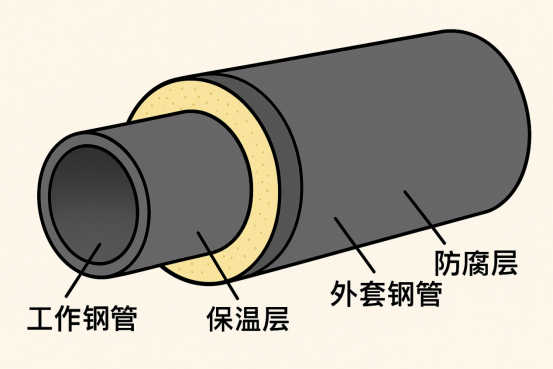
| Component | Function | Working Principle |
|---|---|---|
| Working Steel Pipe | Conveying medium (steam, hot water, etc.) | The medium flows inside the steel pipe, ensuring safe transport and stable pressure. |
| Insulation Layer | Thermal insulation, preventing heat loss | Uses low-thermal-conductivity materials to block heat transfer and maintain medium temperature. |
| Outer Steel Casing | Mechanical protection | Bears external pressure and impact, protecting the insulation layer from damage. |
| Anti-corrosion Coating | Preventing corrosion and water infiltration | Blocks groundwater and chemical substances, extending the service life of the pipeline. |
(1) Working Pipe Preparation
Based on design requirements, seamless steel pipes, SSAW steel pipes, or LSAW steel pipes are selected as working pipes. Particularly for steel jacketed steam pipes transporting high-temperature media, material selection must be strictly controlled.
Rust removal treatment is performed to achieve the specified surface cleanliness, enhancing the adhesion between the anti-corrosion layer and the insulation layer.
(2) Anti-Corrosion Treatment
Apply anti-corrosion coatings or install protective layers on both inner and outer surfaces of the working pipe to prevent direct contact with the medium, thereby effectively inhibiting corrosion.
(3) Insulation Layer Fabrication
Tightly wrap insulation materials (such as composite silicate, rock wool, or polyurethane foam) around the outer surface of the working pipe.
The insulation layer must be uniformly thick, structurally dense, and void-free to minimize thermal bridging effects and ensure optimal thermal performance.
(4) Outer Steel Pipe Fabrication
Fabricate the outer steel pipe to design dimensions, typically using anti-sorrosion spiral steel pipes or straight seam welded pipes as the protective shell.
Apply additional corrosion protection to its outer surface. Common coatings include Triple Polyethylene (3PE), epoxy coal tar asphalt, or IPN8710 to enhance overall durability.
This structure ultimately forms a steel-in-steel direct-buried insulated pipeline offering excellent mechanical strength and thermal insulation properties. It is widely used in district heating, steam transportation, and similar engineering applications.
.jpg "Double-Wall Insulated Steel Pipe")
| Nominal Diameter DN (mm) | Working Steel Pipe Outer Diameter (mm) | Working Steel Pipe Wall Thickness (mm) | Insulation Layer Thickness (mm) | Outer Steel Casing Outer Diameter (mm) | Outer Steel Casing Wall Thickness (mm) | Applicable Medium Temperature (°C) |
|---|---|---|---|---|---|---|
| 50 | 57 | 3.5 | 50 | 159 | 4.0 | ≤350 |
| 80 | 89 | 4.0 | 50 | 219 | 4.5 | ≤350 |
| 100 | 108 | 4.0 | 60 | 245 | 4.5 | ≤350 |
| 150 | 159 | 4.5 | 65 | 325 | 4.5 | ≤350 |
| 200 | 219 | 6.0 | 70 | 377 | 5.0 | ≤350 |
| 250 | 273 | 6.0 | 80 | 426 | 5.0 | ≤350 |
| 300 | 325 | 6.0 | 80 | 480 | 5.0 | ≤350 |
| 400 | 426 | 8.0 | 90 | 630 | 6.0 | ≤350 |
| 500 | 529 | 8.0 | 100 | 720 | 6.0 | ≤350 |
| 600 | 630 | 8.0 | 100 | 820 | 6.0 | ≤350 |
| 800 | 820 | 10.0 | 110 | 1020 | 8.0 | ≤350 |
| 1000 | 1020 | 10.0 | 120 | 1220 | 8.0 | ≤350 |
Urban Heating: Whether for centralized heating or district heating, insulated steel pipes can minimize heat loss during transportation, improve energy efficiency, and reduce heating costs.
Petroleum and Chemical Industry: In the petroleum, natural gas, and chemical industries, they are used to transport high-temperature crude oil, steam, chemical raw materials, etc., ensuring stable transportation of fluids at specific temperatures and preventing solidification or chemical reactions.
Freezing and Refrigeration: Conversely, in scenarios requiring low-temperature transportation, such as liquefied natural gas (LNG) or cold storage, they effectively isolate external heat to prevent the medium from warming up.
Other Industries: For example, in steam pipelines in the power industry, slurry transportation pipelines in mining and metallurgy industries, etc double-wall insulated steel pipes are the cornerstone for maintaining system operations.
.jpg "Double-Wall Insulated Steel Pipe")
(1) How to choose the appropriate insulation material?
Problem Description:
Faced with multiple insulation options like polyurethane, glass wool, and calcium silicate, procurement personnel struggle to determine which material suits their project.
Solution:
Selection depends on the temperature of the medium being transported through the pipeline.
Polyurethane foam insulation pipes are currently the most widely used and cost-effective option, suitable for media with operating temperatures below 140°C (such as hot or warm water).
If the medium temperature exceeds 140°C, high-temperature resistant materials like ultra-fine glass wool or calcium silicate must be selected.
When procuring, clearly communicate the maximum medium temperature to seamless steel pipe suppliers to ensure they recommend the appropriate material.
(2) How to Ensure the Corrosion Resistance and Service Life of Prefabricated Insulated Steam Pipes?
Problem Description:
Steel jacketed steam pipes are typically buried underground, facing corrosion threats from groundwater and soil. Inadequate anti-corrosion measures may accelerate pipe degradation, leading to costly replacements.
Solution:
The corrosion resistance of steel sleeve insulated steel pipes primarily depends on the anti-corrosion coating applied to the outer steel casing. Common solutions include high-density polyethylene (HDPE) coating and epoxy resin coating.
When procuring, require suppliers to provide explicit anti-corrosion standards and test reports, such as outer casing wall thickness, coating thickness, and relevant national/industry standards.
Simultaneously, verify whether the supplier offers a comprehensive joint treatment solution, as corrosion at connection points is often the weakest link in the system.
(3) How to Select Appropriate Pipe Specifications and Wall Thickness for Projects?
Problem Description:
A common challenge faced by many procurement professionals is uncertainty about how to reasonably determine the diameter, wall thickness of the working pipe and outer casing, as well as the insulation layer thickness based on actual project requirements. Incorrect choices may lead to insufficient pressure-bearing capacity, substandard insulation performance, or even unnecessary material cost wastage.
Solution:
Consider the following three aspects:
(1) Working Pipe Selection:
The material and wall thickness of the working pipe should primarily be determined by the temperature, pressure, and design flow rate of the conveyed medium, while strictly adhering to national or industry pipeline design codes.
(2) Insulation Layer Determination:
The insulation layer thickness should be designed based on the project's thermal performance requirements and the ambient operating temperature. Using high density polyurethane foam steel pipe insulation can enhance thermal efficiency. Close communication with suppliers is recommended, as they typically provide scientifically sound thickness recommendations based on thermal calculations.
(3) Outer Protective Pipe Selection:
The critical factor for outer protective pipes is their mechanical protection capability. Wall thickness must be determined based on pipeline burial depth and potential external loads, ensuring sufficient compression resistance and deformation resistance to guarantee long-term stable operation of the entire pipeline system.
(4) How to Evaluate a Supplier's Production Capability and Product Quality?
Problem Description:
Numerous manufacturers of insulated steel pipes exist in the market, with significant variations in product quality. Buyers often face risks such as non-compliant products, project delays, and construction quality hazards due to selecting the wrong supplier.
Solution:
When selecting suppliers, price should not be the sole criterion. A comprehensive evaluation is recommended based on the following aspects:
(1) Verify Production Equipment:
High-temperature pre insulated pipelines require advanced manufacturing facilities, such as automated foaming lines and online quality inspection systems, which are fundamental to ensuring product consistency and performance.
(2) Confirm Corporate Qualifications:
Require suppliers to provide essential certification documents, including valid ISO 9001 Quality Management System certification and Special Equipment Manufacturing Licenses (e.g., for pressure pipeline components).
(3) Review Project Track Record:
Evaluate whether the supplier has successfully supplied steel-in-steel insulated steel pipes for large-scale or key projects to assess their actual delivery capability and reliability.
(4) Sampling and Testing Verification:
Request physical samples for independent testing and verify quality certificates and factory inspection reports for raw materials (e.g., steel pipes, polyurethane) to ensure products meet design specifications.
(5) How should insulation and corrosion protection be implemented at pipe joints?
Problem Description:
Field joints in piping systems represent a critical vulnerability for insulation and corrosion protection. Improper handling can easily create thermal bridges and corrosion initiation points, leading to reduced system efficiency and shortened service life.
Solution:
This aspect requires particular attention. It is recommended that suppliers be explicitly required during the procurement phase to provide a comprehensive field joint treatment plan covering material specifications, standard procedures, and on-site technical support.
For various types of insulated pipes steel jacketed preinsulated pipes, the standard practice involves sealing and insulating joints with specialized foam jointing compounds or compatible heat-shrinkable tapes after welding inspection approval.
Crucially, jointing materials must be compatible with the main pipe's performance characteristics. Suppliers should provide clear technical guidance to ensure consistent quality throughout the project.
 WeChat
 Scan wechat
WhatsApp:+86 15383177997
E-mail:wr@insulatedpipeline.com
E-mail:
Address:Development Zone, Cangzhou, Hebei Province, China
技术支持:沧州利畅网络
.jpg)
.jpg)