EMAIL:
wr@insulatedpipeline.com


Published:2025-08-04 | Last Updated: 2025-08-30 Views: 168
.jpg "Direct-Buried Preinsulated Steam Pipeline")
Direct-buried preinsulated steam pipeline employ a composite structure comprising a “working pipe—insulation layer—outer casing,” integrated with a sliding guide system. This design enables the safe and efficient transportation of high-temperature steam, representing a typical high-temperature pre-insulated pipeline.
(1) Working Tube (Inner Layer)
Material: Typically 20# seamless steel pipe (GB/T 8163) or large-diameter SSAW steel pipes (wall thickness deviation ≤5%).
Function: Conveys high-temperature steam (130°C–350°C), designed for pressures ≤2.5MPa. Sandblasted for rust removal (Sa2 grade) and treated with anti-corrosion coating. Both ends reserved with 200mm welding zones. Welds 100% ultrasonically tested and approved.
(2) Insulation Layer (Middle Layer)
Material: Ultra-fine glass wool (temperature resistance ≥450℃) or silica-alumina needle-punched felt. Layered and bundled with an aluminum foil reflective layer (reflectivity ≥95%). Auxiliary layer: Air gap (external sliding type, drainage insulation) or polyurethane foam (internal sliding type, closed-cell rate ≥90%).
Function: Provides high-efficiency steam pipe insulation controls outer surface temperature ≤50°C. Aluminum foil enhances thermal reflection efficiency; polyurethane or air gap improves waterproofing and compression resistance.
.jpg "Direct-Buried Preinsulated Steam Pipeline")
(3) Outer Steel Casing (Outer Layer)
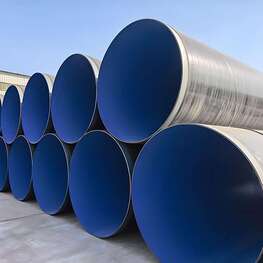
Material: Q235B spiral welded pipe, wall thickness increases with diameter and load (e.g., DN500 wall thickness ≥10mm).
Function: Protects insulation layer, resists earth pressure and thermal stress (≥0.08MPa). External anti-corrosion uses 3PE or epoxy coal tar asphalt; internal wall coated with epoxy powder. Thickened and reinforced anti-corrosion required for pipe jacking construction.
(4) Sliding Guide System
Components: Includes stainless steel fastening bands and PTFE sliding blocks.
Function: Enables thermal displacement of the working pipe within the steel jacketed steam pipe reduces friction, and prevents insulation layer damage. Guide brackets installed every 6 meters; spacing and insulation around compensators adjusted as required.
| Structure Type | Inner sliding type | Outer sliding type |
|---|---|---|
| Insulation layer | Polyurethane foam + microporous calcium silicate + aluminum foil reflective layer | Ultra-fine glass wool + aluminum foil reflective layer + air layer |
| Sliding method | The working pipe slides inside the insulation layer. | An air layer is provided between the insulation layer and the outer casing; the working pipe drives the insulation layer to slide. |
| Heat loss | Lower (171.6 W/m) | Slightly higher (176.6–208.9 W/m) |
| Applicable scenarios | High-temperature steam (>300 °C) with strict temperature control requirements | Humid areas or locations with high drainage needs and relaxed heat-dissipation requirements |
| Advantages | Compact structure, superior thermal insulation performance | Good drainage performance, reduced moisture accumulation |
(1) Drainage System
Installed at both ends of the outer sliding structure, one set per pipe section, to promptly discharge moisture from the insulation layer and prevent internal corrosion. This design is commonly found in steel-in-steel insulated steel pipes.
(2) Expansion Compensation
Corrugated pipes or natural expansion structures may be used in conjunction with internal fixed supports to reduce the number of concrete piers.
(3) End Sealing
Temporary sealing is applied to both pipe ends outside the insulation layer to prevent moisture ingress during construction. These seals are removed after installation. This process is standard practice for steel jacketed preinsulated pipes.
(4) Joint Corrosion Protection
Glass fiber, 3PE, or dual-layer epoxy powder reinforcement is applied to the outer casing joints for enhanced corrosion protection. All protective coatings must pass 5000V spark testing.
.jpg "Direct-Buried Preinsulated Steam Pipeline")
| Parameter | Description | Unit | Remarks |
|---|---|---|---|
| Operating temperature | Maximum continuous steam temperature the direct-buried preinsulated steam pipeline can withstand | °C | Typical range: –30 °C to 350 °C. Special materials and insulation layers are required for high-temperature steam lines. |
| Operating pressure | Maximum allowable pressure of the heating steam pipe (usually 1.5 times the design pressure) | MPa | Common design pressures are 1.6 MPa and 2.5 MPa, depending on system requirements. |
| Thermal conductivity (insulation) | Thermal conductivity of the polyurethane-foam insulation layer, indicating insulation performance | W/(m·K) | PU insulation typically has a conductivity of 0.022–0.033 W/(m·K). |
| Insulation thickness | Thickness of the insulation material, affecting thermal insulation and heat loss | mm | Common thickness range: 50 mm to 200 mm, determined by local climate and steam temperature. |
| Inner pipe material | Material of the inner steel pipe, determining pressure resistance and high-temperature performance | — | Typical steels: 20# carbon steel, Q235, 316 stainless steel; choice depends on operating conditions and pressure requirements. |
| Outer casing material | Material of the outer casing, protecting the pipe from soil corrosion and external mechanical damage | — | Common casings: HDPE or steel pipe; steel casings provide stronger corrosion and impact resistance. |
| Design service life | Intended service life of the steel-in-steel direct-buried insulated pipeline, influencing overall investment and maintenance cycles | years | Design life is generally 30 years; actual life can be longer depending on material quality and construction. |
| Corrosion-protection class | Corrosion-protection requirement for the outer casing, determining suitability under different soil conditions | — | Typical methods: epoxy coating, hot-dip galvanizing, PE jacketing. Class is selected according to soil aggressiveness. |
| Laying method | Method of installing the steel jacketed steam pipe, affecting construction difficulty, speed, and surface occupation | — | Primary method: direct burial, suitable where ground conditions allow; trenchless installation or crossing underground structures is also possible. |
| Heat-loss rate | Heat loss during steam transmission, directly affecting energy efficiency | % | With good insulation, heat-loss rate is usually kept within 5 %–10 %, depending on pipeline length and temperature difference. |
| Standard / Specification | Code | Content Summary | Scope of Application |
|---|---|---|---|
| Steel Pipe Standard | GB/T 8163 | Standard for seamless steel pipes used for fluid transport; applicable to inner pipes of prefabricated insulated steam pipes. | Design and manufacture of various fluid-conveying pipelines. |
| Pipeline Material | GB/T 9711 | Steel pipes for oil and gas industry pipelines; specifies steel grades suitable for internal pressure-bearing service. | Design and construction of pressure pipelines. |
| Polyurethane Insulation Standard | GB/T 18315 | Rigid polyurethane foam thermal insulation steel pipes; covers PU foam properties (thermal conductivity, density, compressive strength, etc.) for heating pipelines. | Selection and inspection of thermal insulation materials for heating pipes. |
| Pipeline Outer Jacket | GB/T 18248 | Standard for HDPE outer jackets—manufacturing requirements for anti-corrosion and waterproof protective layers. | Anti-corrosion protection and outer jacket materials for pipelines. |
| Pipeline Corrosion Protection | GB/T 20872 | Coating requirements for external anti-corrosion layers of steel pipes, including epoxy coatings to resist soil corrosion in buried conditions. | Underground pipelines and steel pipe anti-corrosion projects. |
| Installation Code | GB 50251 | Quality acceptance code for pipeline installation; details laying, welding, jointing, inspection, and acceptance. | Construction and acceptance of all pipeline projects. |
| Direct-Buried Pipeline Design | GB/T 50124 | Design code for direct-buried pipelines—requirements for layout, embedment methods, and pressure resistance. | Design and construction of direct-buried pipelines. |
| Construction Technical Requirements | JGJ/T 174 | Technical specification for thermal insulation steel pipe construction—detailed procedures for insulation application, pipe jointing, etc. | Construction of steam and hot-water insulated pipelines. |
| Thermal Network Operation | GB 50429 | Operation and maintenance standard for thermal pipeline systems—inspection, maintenance, and patrol requirements. | Daily operation and maintenance management of thermal networks. |
| Steam Pipeline Insulation | GB/T 13041 | Design and construction standard for steam pipeline insulation—material selection, thickness requirements, and insulation work. | Insulation design and construction of steam pipelines. |
| Pipeline Compressive Load Standard | GB/T 50057 | Testing standard for external loads on direct-buried pipelines—soil pressure and traffic loading. | Load standards for urban underground direct-buried pipelines. |
| Anti-Frost Standard | GB/T 8163-2008 | Insulation standard for steel pipes in freezing regions—special anti-frost requirements (thickness, sealing) for direct-buried steam pipelines in cold areas. | Design and construction of steam pipelines in cold climates. |
High-efficiency thermal insulation: Thermal conductivity ≤ 0.08 W/(m·K), reducing heat loss by over 60%.
Long service life: Design service life ≥ 30 years, corrosion rate of the anti-corrosion layer ≤ 0.01 mm/year.
Easy Installation: Direct burial installation reduces earthwork volume by 50% and shortens construction time by 50%.
Safe and Reliable: Internal fixed structure reduces the need for concrete piers, minimizing thermal bridging and water penetration risks.
 WeChat
 Scan wechat
WhatsApp:+86 15383177997
E-mail:wr@insulatedpipeline.com
E-mail:
Address:Development Zone, Cangzhou, Hebei Province, China
技术支持:沧州利畅网络
.jpg)
.jpg)