
EMAIL:
wr@insulatedpipeline.com



Number of visits:24 seconds Update time:2026-06-11
For large-scale offshore engineering projects—such as marine construction, cross-border offshore gas transmission, and deepwater oil and gas development involving tens of thousands of tons of steel—procurement of Spiral Submerged Arc Welded (SSAW) steel pipes is a high-stakes decision with zero tolerance for failure.
The specific nature of offshore projects means that every day involves hundreds of thousands of dollars in vessel chartering costs, extremely limited weather windows for pipe laying, and subsea service conditions that must remain leak-free for decades.
When selecting long-term partners, procurement teams are often confronted with aggressive marketing claims from manufacturers. This article provides a professional offshore procurement perspective on how to look beyond surface-level data and truly evaluate an SSAW pipe manufacturer’s delivery capability and quality control system.
Large offshore orders are typically characterized by high volume, tight schedules, and multiple specifications. Therefore, delivery capability should not be judged solely by a manufacturer’s stated annual production capacity, but rather by the following four critical indicators:
Forming and welding speed capability:
SSAW pipe production speed is primarily limited by forming machines and submerged arc welding systems. It is essential to evaluate whether the manufacturer operates multiple parallel forming lines equipped with double-sided submerged arc welding (SAW) systems for both internal and external welds.
Bottleneck process analysis:
In many cases, production bottlenecks are not caused by welding, but by downstream processes such as hydrostatic testing, anti-corrosion coating (3PE/3PP), and precision pipe end beveling. It is critical to ensure that the throughput capacity of these finishing processes fully matches upstream welding production lines.
Offshore pipeline steel (such as API 5L X65MS / X70MS sour-service and high-deformation-resistant grades) is not standard commodity steel. Its production requires collaboration with top-tier steel mills.
Evaluation method:
Review long-term strategic cooperation agreements (MOUs) between the manufacturer and major global steel producers such as China Baowu, Ansteel, JFE Steel, or POSCO. Assess their ability to secure delivery schedules for steel coils and their influence in customizing special chemical compositions. Without a stable upstream supply chain, even the largest pipe manufacturing capacity is meaningless.
Large-diameter, thick-wall SSAW pipes are bulky, expensive to transport overland, and highly susceptible to end damage.
Key evaluation point:
Does the manufacturer own or have exclusive access to a dedicated bulk cargo or container shipping terminal? Alternatively, is the factory located near a deep-water port? This directly determines whether tens of thousands of tons of steel pipes can be shipped “directly from production to vessel loading,” minimizing secondary handling damage and ensuring strict adherence to marine shipping schedules.
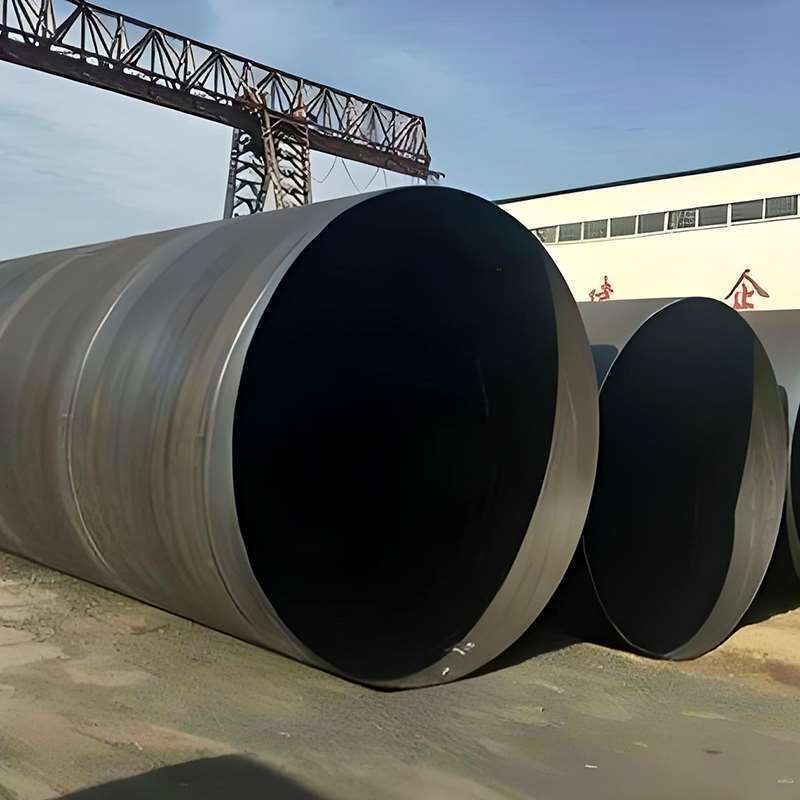
Offshore projects impose extremely strict requirements on SSAW pipe dimensional accuracy (ovality, misalignment) and internal defect control. A qualified offshore-grade QC system must form a complete closed-loop structure with the following four pillars:
In SSAW manufacturing, weld quality is the most critical control point. Leading offshore-grade manufacturers typically implement a three-layer NDT defense system:
Raw material plate/coil UT inspection → In-line ultrasonic weld inspection (UT) → Post-hydrostatic off-line UT + X-ray (RT) spot/full inspection
First stage:
100% plate/coil ultrasonic testing upon material entry to eliminate internal lamination defects in steel plates.
Second stage:
Continuous in-line automated ultrasonic testing (UT) after welding to monitor real-time weld defects such as porosity, slag inclusion, and lack of fusion.
Third stage:
After hydrostatic testing, off-line ultrasonic re-inspection is performed, followed by X-ray (RT) inspection or digital radiography on pipe ends and critical areas to ensure fully traceable imaging records.
During offshore pipe-laying operations, excessive pipe end ovality, out-of-roundness, or wall thickness deviation can lead to welding failure or significantly reduce installation efficiency.
Evaluation method:
Check whether the manufacturer is equipped with a laser-based automatic pipe end measurement system. This system captures real-time geometric data for each pipe. For offshore orders, pipe end ovality is typically required to be controlled within ±0.5% or even tighter, which is significantly stricter than standard API 5L requirements.
Due to the spiral forming process and continuous weld seam, SSAW pipes generally exhibit more complex residual stress distribution compared to longitudinally welded (LSAW) pipes.
Key quality differentiator:
Verify whether the manufacturer applies in-line medium-frequency induction heating for stress relief (hydrogen removal / normalizing treatment). Additionally, assess whether the laboratory is capable of performing CTOD (Crack Tip Opening Displacement), HIC (Hydrogen Induced Cracking), and SSCC (Sulfide Stress Corrosion Cracking) testing, or has established qualified third-party testing partnerships. These capabilities are critical for verifying long-term performance in extreme subsea environments.
During factory audits conducted with technical teams and third-party inspection agencies such as DNV, ABS, or Lloyd’s Register, attention should shift away from office facilities and focus on the following operational details:
1. First-piece and shift-change inspection records:
Randomly review “first article inspection reports” and shift handover inspection logs for offshore production batches to verify whether the three-inspection system (self-inspection, mutual inspection, and dedicated inspection) is genuinely implemented rather than retroactively documented.
2. Defect repair control system:
All manufacturing processes will inevitably generate weld defects. The key factor is the repair rate and repair discipline. Offshore pipeline standards typically limit rework on the same area to no more than two times. Review the welding repair procedure specifications and verify whether actual repair operations include proper preheating and mandatory re-NDT inspection after repair.
3. Traceability and marking system:
Randomly select a finished pipe and require the QC team to trace, within five minutes, its full production history via marking or barcode system. This should include steel coil heat number, chemical composition report, welding operator ID, hydrostatic test pressure curve, and coating thickness records.
A manufacturer that cannot achieve full “one pipe–one file” digital traceability should never be considered for large-scale offshore projects.
The delivery and quality assurance of large offshore SSAW pipe orders is ultimately a test of organizational precision and engineering integrity.
Qualified SSAW pipe manufacturers internalize quality control as part of their production DNA, rather than treating it as a superficial compliance requirement for inspections.
For procurement teams, evaluating production redundancy, supply chain stability, multi-layer NDT systems, and full-process digital traceability provides a reliable framework to accurately identify manufacturers capable of supporting critical offshore projects with safety, reliability, and long-term performance assurance.
 WeChat
 Scan wechat
WhatsApp:+86 15383177997
E-mail:wr@insulatedpipeline.com
E-mail:
Address:Development Zone, Cangzhou, Hebei Province, China
技术支持:沧州利畅网络


.jpg)
