
EMAIL:
wr@insulatedpipeline.com



Number of visits:23 seconds Update time:2026-06-08
In offshore engineering, offshore oil drilling, and subsea gas transmission projects, subsea pipelines are widely regarded as the “lifeline” of the entire project. However, the marine environment—characterized by high salinity, high humidity, and complex microbial activity—represents one of the most demanding service conditions for steel pipelines.
For procurement teams in offshore projects, the key question when selecting Spiral Submerged Arc Welded (SSAW) steel pipes is: how can large-diameter pipelines reliably operate in deep-sea or tidal zones for 30, or even 50 years?
A qualified SSAW pipe manufacturer does not simply supply steel pipes—it delivers a fully engineered anti-corrosion system. This article breaks down how leading manufacturers build a robust corrosion protection barrier through materials, processes, and technological innovation.
The foundation of corrosion resistance begins with the steel plate (coil) itself. Facing risks such as Stress Corrosion Cracking (SCC) and Hydrogen Induced Cracking (HIC) in marine environments, reputable manufacturers enforce strict raw material controls from the very beginning:
High-Purity Clean Steel
Manufacturers typically adopt ultra-low carbon, ultra-low sulfur, and ultra-low phosphorus pipeline steel grades (such as high-grade API 5L steels including X65QS or X70M). Secondary refining processes are used to reduce non-metallic inclusions, as inclusions are primary initiation sites for pitting corrosion.
Micro-Alloying & Thermo-Mechanical Controlled Processing (TMCP)
Micro-alloying elements such as Niobium (Nb), Vanadium (V), and Titanium (Ti) are introduced to refine the grain structure and improve toughness. A properly controlled microstructure significantly reduces the risk of hydrogen blistering caused by acidic media such as H₂S in seawater environments.
In marine engineering, bare steel pipes can be severely corroded within months. SSAW manufacturers design tailored coating systems based on different offshore service zones, including above-water decks, splash zones, and subsea burial zones.
For SSAW pipelines installed on the seabed or buried in marine sediments, Three-Layer Polyethylene (3PE) or Three-Layer Polypropylene (3PP) coatings are industry standards. These systems combine the advantages of three functional layers:
Bottom Layer (Fusion Bonded Epoxy, FBE): Provides excellent adhesion and outstanding cathodic disbondment resistance.
Intermediate Adhesive Layer: Bonds the epoxy layer to the outer polyolefin layer.
Outer Layer (HDPE or PP): Provides mechanical protection against seabed abrasion, anchor impact, and high-pressure water erosion. (Note: 3PP is preferred for higher-temperature deep-sea pipelines.)
For large-diameter offshore SSAW pipeline projects, Concrete Weight Coating (CWC) is often applied over the 3PE layer to counteract buoyancy and provide additional mechanical protection. This not only stabilizes the pipeline on the seabed but also forms a rigid barrier against marine organisms such as barnacles and shellfish.
The splash zone is the most aggressive corrosion area in marine environments due to continuous wet-dry cycles and high oxygen exposure. For SSAW pipe piles or structural components in this zone, manufacturers apply ultra-thick epoxy systems (e.g., glass-flake reinforced epoxy) or Thermal Sprayed Aluminum/Zinc coatings (TSA/TSZ), which offer significantly superior abrasion and oxidation resistance compared to conventional coatings.
When SSAW pipelines are used to transport seawater, high-salinity formation water, or acidic oil and gas media, internal corrosion protection becomes equally critical.
Liquid Epoxy Coating (Dual Function: Corrosion Protection & Flow Efficiency)
Manufacturers apply liquid epoxy coatings compliant with API RP 5L2 standards on the internal pipe surface. This coating not only isolates the steel substrate from corrosive media but also significantly reduces internal roughness, thereby improving flow efficiency and reducing pumping energy consumption.
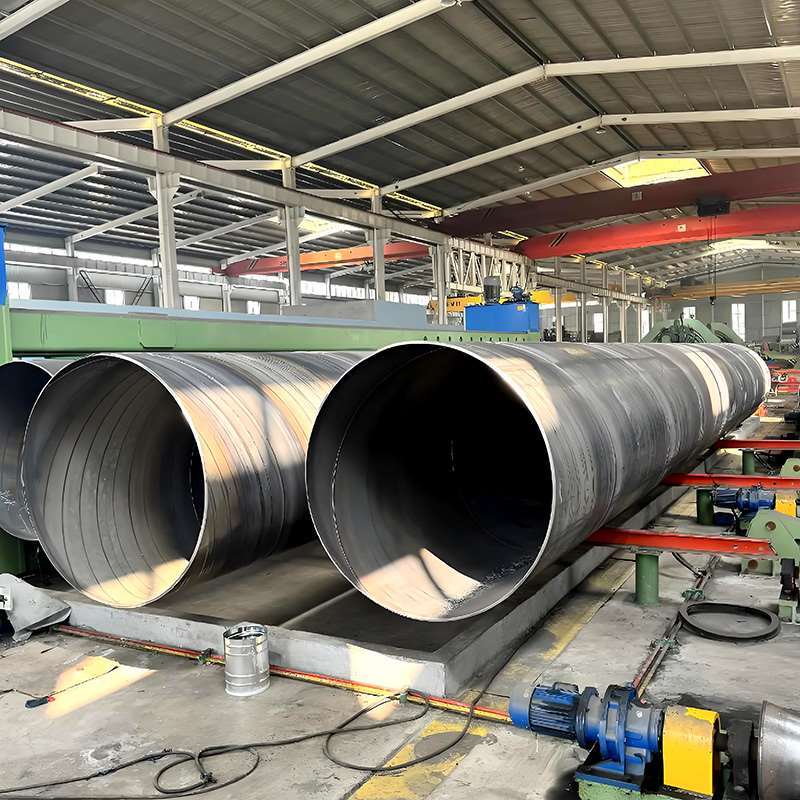
SSAW pipes feature a continuous helical weld seam, which often raises concerns among buyers: Will the weld seam become a weak point in corrosion protection?
Qualified manufacturers address this through advanced process control:
Precision Welding Parameter Control
Multi-wire submerged arc welding (e.g., tandem wire systems with leading, middle, and trailing wires) is used to ensure high-quality double-sided weld formation. Weld reinforcement height is strictly controlled (typically < 3 mm). A smooth weld profile ensures uniform coating application and prevents air entrapment or uneven coating thickness.
Post-Weld Heat Treatment / Stress Relief
Welding introduces residual stresses, which can accelerate corrosion and stress corrosion cracking. Through controlled online or offline heat treatment, residual stress in the weld and heat-affected zone is eliminated, and the metallurgical structure is homogenized, ensuring corrosion resistance comparable to the base material.
For offshore engineering procurement, corrosion performance must be verified not only through design specifications but also through rigorous testing data. A qualified SSAW manufacturer must conduct the following pre-shipment inspections:
| Test Item | Purpose | Procurement Focus |
|---|---|---|
| 100% NDT (UT / RT) | Detect internal weld defects such as porosity, cracks, and lack of fusion | Prevent localized corrosion initiation due to internal defects |
| Cathodic Disbondment Test | Simulate coating performance under cathodic protection in seawater | Evaluate FBE adhesion and prevent large-scale coating delamination |
| Bending & Impact Tests | Simulate stresses during offshore pipe laying (S-lay / J-lay installation) | Ensure coating integrity under controlled deformation |
| Holiday Detection (Spark Testing) | 100% surface scanning for pinholes or coating holidays | Even a single defect can develop into severe pitting corrosion in seawater |
When evaluating whether an SSAW pipe manufacturer truly has offshore corrosion protection capabilities, certifications alone are not sufficient. Procurement teams are advised to assess manufacturers from the following three practical dimensions:
1. Integrated Coating Facility
Check whether pipe manufacturing and coating application are performed within the same production site. Integrated facilities significantly reduce the risk of initial oxidation during storage and transportation of bare pipes.
2. Pipe End Treatment Details
Offshore field welding requires extremely high precision. Evaluate how the manufacturer handles coating-free ends, bevel protection, and weldable anti-rust coatings, as these directly affect offshore installation efficiency.
3. Proven Offshore Track Record
Request real project references in similar water depths and salinity conditions, along with third-party inspection reports from classification societies such as DNV, ABS, or Lloyd’s Register.
 WeChat
 Scan wechat
WhatsApp:+86 15383177997
E-mail:wr@insulatedpipeline.com
E-mail:
Address:Development Zone, Cangzhou, Hebei Province, China
技术支持:沧州利畅网络
.jpg)
.jpg)