EMAIL:
wr@insulatedpipeline.com



Number of visits:21 seconds Update time:2026-07-03
To secure contracts with the lowest bid, some coating manufacturers cut corners by using inferior raw materials or simplifying production processes. To minimize quality risks, the following requirements should be clearly specified in the technical agreement before placing an order.
The most expensive component of a 3PE coating is the outer polyethylene (PE) layer. Some manufacturers reduce costs by blending recycled plastic into virgin polyethylene. Although the coating may appear acceptable initially, it can become brittle and crack after prolonged exposure to sunlight at the construction site.
Procurement Recommendation
The contract should require the supplier to provide the original Mill Test Certificates (MTCs) for both the polyethylene and the fusion bonded epoxy (FBE) powder.
It should also specify that the primary coating materials must come from recognized domestic or international manufacturers (such as Borealis, PetroChina, Sinopec, or equivalent approved suppliers), and explicitly prohibit the use of recycled or reprocessed polyethylene.
When purchasing spiral steel pipe, excessive weld reinforcement can create coating defects. A weld bead that is too high may cause insufficient coating thickness or localized voids alongside the weld during the 3PE coating process.
Procurement Recommendation
Include a clause similar to the following in the technical specification:
Before coating, the seller shall grind and smooth the weld reinforcement on SSAW steel pipes. If the weld reinforcement exceeds the specified limit (for example, greater than 1.5 mm), any coating defects—including holiday detector failures resulting from insufficient coating thickness or void formation around the weld—shall be repaired at the seller's expense.
Whether you personally visit the coating plant or assign a third-party inspector for production supervision, you do not need to focus on complex production parameters. Instead, paying close attention to the following three high-risk areas can effectively discourage manufacturers from cutting corners.
| Inspection Area | Common Cost-Cutting Practices | How to Verify On Site |
|---|---|---|
| 1. Surface Preparation (Blast Cleaning) | Inadequate rust removal or reuse of worn-out steel grit that has broken down into fine particles, resulting in poor FBE adhesion and increased risk of future cathodic disbondment. | Inspect the surface appearance and anchor profile. Properly blast-cleaned steel should exhibit a gray-white metallic finish corresponding to Sa 2.5 cleanliness. The surface should feel rough, similar to sandpaper. If it appears dark, blackened, or smooth, stop production immediately for investigation. |
| 2. Epoxy Powder Application Area | Applying an excessively thin FBE layer or leaving areas uncoated, relying primarily on the adhesive layer instead of a properly applied epoxy primer, which significantly reduces corrosion protection. | Observe the spray operation and powder recovery system. Verify that all spray guns are operating correctly and that the powder recovery equipment is functioning properly throughout production. |
| 3. Coating Thickness Inspection Area | Measuring coating thickness only on the pipe body while ignoring weld seams and pipe ends, or using coating thickness gauges that have not been properly calibrated. | Perform random verification at critical locations. Use your own portable coating thickness gauge to measure the weld crown and the area approximately 100 mm inward from the pipe bevel, where insufficient coating thickness most commonly occurs. |
Once the coated pipes arrive at the construction site or your warehouse, a systematic receiving inspection should be carried out before acceptance.
Do not rely solely on the supplier's certificate of conformity. Request the following inspection documents.
This report confirms that the entire coating is free of holidays (pinholes or coating defects). Standard 3PE coatings are typically required to pass 100% online holiday detection at 25 kV.
This report provides direct evidence of the coating's resistance to cathodic disbondment. At approximately 20°C, the peel strength should meet the applicable specification, typically ≥ 100 N/cm.
Do not accept statements such as "the average coating thickness meets the requirement."
Instead, verify that the minimum measured coating thickness complies with the specification. Depending on the pipe diameter, the minimum acceptable coating thickness typically ranges from 1.7 mm to 2.5 mm.
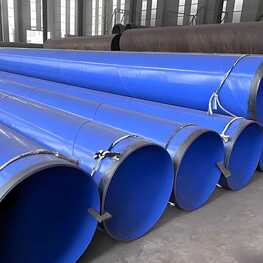
Factory-coated 3PE pipes should have 100 mm to 150 mm of bare steel exposed at both ends to facilitate field welding.
Inspect whether the edge of the coating has been machined into a smooth taper, with a bevel angle typically not exceeding 30°.
If the coating ends abruptly with a sharp vertical edge, the coating is much more susceptible to lifting or peeling during transportation, handling, and installation.
The polyethylene outer layer should have a smooth, uniform appearance with consistent color.
If numerous blister-like bubbles are visible on the surface, or if the coating at the pipe end can be easily peeled away by hand, the coating quality is unacceptable and the shipment should not be accepted until the defects have been properly investigated and resolved.
 WeChat
 Scan wechat
WhatsApp:+86 15383177997
E-mail:wr@insulatedpipeline.com
E-mail:
Address:Development Zone, Cangzhou, Hebei Province, China
技术支持:沧州利畅网络
.jpg)