EMAIL:
wr@insulatedpipeline.com



Number of visits:19 seconds Update time:2026-05-28
In international bulk steel pipe procurement, anti-corrosion spiral steel pipe projects often involve very high technical requirements. In many cases, disputes between buyers and suppliers are not about price, but about the definition of “qualified products”.
If you are responsible for procurement in large-scale energy or infrastructure projects, then API 5L (line pipe specification) and DIN 30670 (polyethylene coating standard) are your core reference frameworks. Within these two systems, there are several non-negotiable requirements—meaning that once these criteria are not met, the pipeline may fail within 3–5 years after burial, leading to significant losses.
This article breaks down these critical requirements to help you avoid hidden risks in procurement.
No matter how good the coating is, if the steel pipe itself has insufficient strength or welding defects, the entire system becomes unreliable. For spiral welded pipes (SSAW), the following three points are strictly non-negotiable:
API 5L requires hydrostatic testing on every single pipe. Each pipe must withstand the specified pressure for at least 5 seconds without leakage.
Non-negotiable requirement:
Sampling inspection is not acceptable. If a supplier suggests “sampling is sufficient due to stable production,” it should be rejected.
Spiral steel pipes have a continuous helical weld seam, which is the most stress-sensitive area.
Non-negotiable requirement:
100% ultrasonic testing (UT) or radiographic testing (RT) must be performed. Any lack of fusion, porosity, or crack—even if microscopic—can become a hidden failure point after coating and burial.
Non-negotiable requirement:
Carbon equivalent (CEV) must strictly comply with specification limits. Excessive carbon content increases the risk of cold cracking at weld areas, directly affecting on-site welding performance and installation safety.
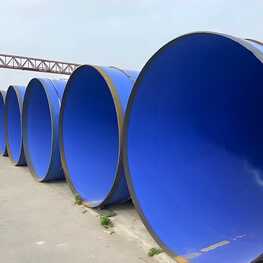
Once the steel pipe enters the coating production line, DIN 30670 becomes the core standard for evaluating the quality of 3LPE (three-layer polyethylene) coating.
Surface preparation is the foundation of coating quality.
Non-negotiable requirement:
Surface cleanliness must reach Sa 2.5 level.
Practical insight:
All rust, mill scale, and contaminants must be completely removed. The anchor profile (surface roughness) should be maintained at 50–75 μm. If surface preparation is insufficient, the coating will behave like tape applied on dust, leading to large-area peeling over time.
DIN 30670 defines different coating thickness classes depending on pipe diameter.
Non-negotiable requirement:
Coating thickness at weld seams is critical. Due to weld reinforcement (weld bead height), coating thickness at the weld crown may reduce. It must not be less than 85% of the specified minimum value.
During production, two inspections determine whether the product can be released for shipment.
This test verifies the bonding strength between epoxy layer, adhesive layer, and polyethylene outer layer.
Non-negotiable requirement:
At 20°C ± 5°C, peel strength should not be lower than 100 N/cm. If the coating can be peeled off easily, it indicates insufficient chemical bonding with the steel surface.
This is the final and most critical test for detecting pinholes, bubbles, and coating defects.
Testing voltage: Typically 10 kV or 25 kV depending on coating thickness.
Non-negotiable requirement:
Full-length, 100% inspection is mandatory. Even a single pinhole can allow moisture ingress, leading to rapid corrosion under the coating.
Do not only check steel pipe certificates. Also request certificates for coating raw materials (epoxy powder, polyethylene pellets). Some low-quality manufacturers may use recycled materials, which can cause coating brittleness and cracking within a few years.
Even if factory coating is excellent, poor field joint coating (such as heat shrink sleeves) that does not comply with DIN 30670 requirements can reduce pipeline service life from 30 years to as low as 5 years.
For large-scale projects, it is strongly recommended to assign third-party inspectors for factory supervision. Key checkpoints include:
Surface blasting temperature control during shot blasting
Preheating temperature before epoxy spraying (typically 180°C–230°C)
Coating process stability and consistency
For anti-corrosion spiral steel pipes, API 5L ensures structural integrity, while DIN 30670 ensures coating performance. These two systems together form the minimum quality baseline for long-distance pipeline projects.
Any deviation from these non-negotiable standards may significantly reduce pipeline service life and lead to costly failures after installation.
 WeChat
 Scan wechat
WhatsApp:+86 15383177997
E-mail:wr@insulatedpipeline.com
E-mail:
Address:Development Zone, Cangzhou, Hebei Province, China
技术支持:沧州利畅网络
.jpg)