EMAIL:
wr@insulatedpipeline.com



Number of visits:22 seconds Update time:2026-06-22
As 3PE technology originated in Europe and is now widely adopted worldwide, oil and gas projects typically specify one or more of the following mainstream standards depending on project location and client requirements:
GB/T 23257-2017 – “Technical Standard for Polyethylene Coating of Buried Steel Pipelines”
This is the most authoritative and widely used domestic standard for 3PE coating systems in China. It provides detailed requirements covering raw material performance, coating application processes, and inspection methods.
SY/T 0413-2002 – “Technical Specification for Polyethylene Coating for Buried Steel Pipelines”
An earlier petroleum and natural gas industry standard. Although many projects have transitioned to GB/T 23257, it is still referenced in legacy projects or specific technical specifications.
ISO 21809-1
An international standard developed by the International Organization for Standardization (ISO) for external coatings on buried and subsea pipeline transportation systems. Part 1 specifically covers polyolefin coatings such as 3PE and 3PP systems.
DIN 30670
A German standard and one of the earliest specifications for 3PE coating systems. It is widely recognized and applied across Europe and international projects.
CAN/CSA-Z245.21
A Canadian standard commonly required in North American projects and in regions influenced by North American engineering specifications.
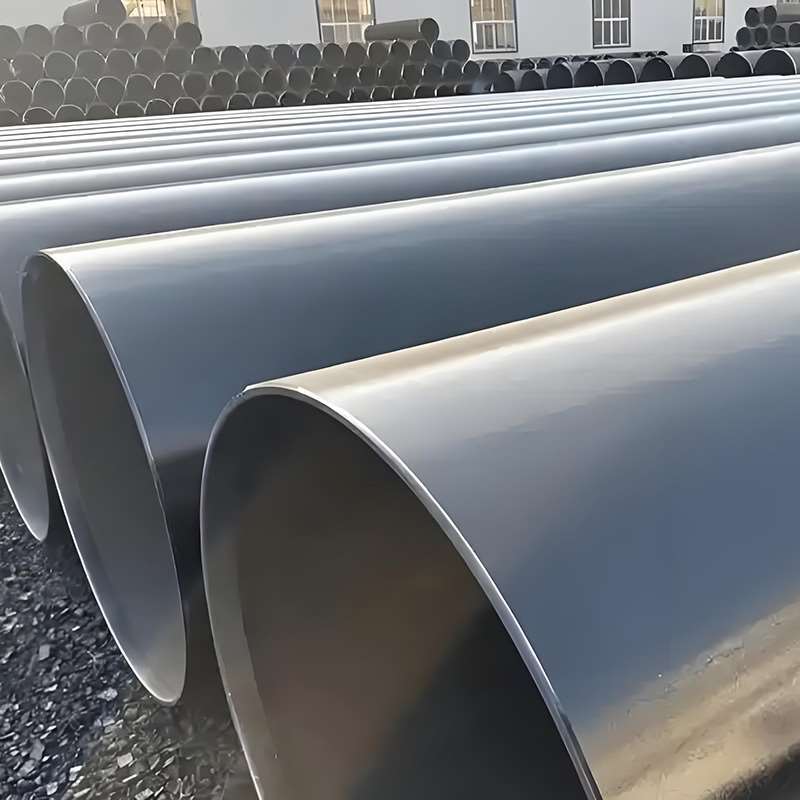
.jpg "3PE Coated Steel Pipe")
A standard 3PE coating consists of three functionally distinct layers. Each layer must meet specified thickness requirements to ensure synergistic corrosion protection performance:
Bottom Layer: Fusion Bonded Epoxy (FBE, thickness ≥ 80 μm)
Directly bonded to the steel pipe surface, providing excellent adhesion and superior cathodic disbondment resistance.
Intermediate Layer: Adhesive (AD, thickness 170–250 μm)
Typically a copolymer-based adhesive that acts as a chemical bonding bridge, firmly connecting the epoxy layer and the outer polyethylene layer.
Outer Layer: High-Density Polyethylene (HDPE, thickness 1.8–3.7 mm depending on diameter)
Provides mechanical protection, resistance to soil stress, water and oxygen barrier performance, and resistance to plant root penetration.
In oil and gas projects, inspection of 3PE coating is implemented throughout the entire lifecycle—from raw material incoming inspection, in-process quality control, to final product release and site acceptance. The following requirements are mandatory:
Before coating application, the steel surface must undergo abrasive blast cleaning, which is the most critical factor determining coating adhesion performance.
Surface cleanliness grade: Must reach Sa 2.5 (near-white metal finish). The surface must be free from visible oil, grease, dirt, mill scale, and rust.
Anchor profile (surface roughness): Typically required to be 50–90 μm, ensuring proper mechanical interlocking of epoxy powder with the steel surface.
Dust and soluble salt content: Surface dust level generally ≤ Grade 2, and soluble salt contamination typically < 20 mg/m² to prevent blistering or coating failure in service.
Appearance quality: The coating surface must be smooth and uniform in color, free from bubbles, pinholes, cracks, or wrinkles.
Pipe ends shall remain uncoated for a length of 100–150 mm (beveled area) to facilitate field welding, and coating edges must be properly chamfered (typically ≤ 30°).
Coating thickness: Measured using a coating thickness gauge at multiple circumferential points. The minimum thickness must comply with the applicable standard.
For example, under GB/T 23257, heavy-duty coatings for pipes with diameter > 500 mm typically require a thickness ≥ 3.5 mm.
Holiday detection is a mandatory acceptance criterion (zero-tolerance item) in oil and gas projects. All coated pipes must pass 100% high-voltage spark testing before shipment.
Test voltage: Typically 25 kV for both standard and heavy-duty coatings during full-surface scanning.
Acceptance criteria: No electrical breakdown or spark leakage is permitted.
To verify internal coating quality, destructive testing is conducted on each batch (e.g., every 100 pipes or per production shift):
| Test Item | Purpose & Industry Requirements (GB/T 23257 reference) |
|---|---|
| Peel Strength | Measures adhesion between coating layers. Typically ≥ 100 N/cm at 20°C, and ≥ 70 N/cm at 50°C or 70°C. |
| Cathodic Disbondment Resistance | Simulates service conditions under cathodic protection. Maximum disbondment radius ≤ 7 mm at 20°C for 28 days, or ≤ 6 mm at 65°C for 48 hours. |
| Impact Resistance | Ensures coating durability during transport and handling. After ≥ 15 J impact energy, no cracking or holiday is permitted. |
| Indentation Resistance | Evaluates resistance to soil load and backfill pressure. Indentation depth must be ≤ 0.2 mm or ≤ 10% of total coating thickness. |
| Flexibility / Mandrel Bend Test | Simulates cold bending conditions. At temperatures such as 0°C or -30°C, bending at 2.5°/PD must not cause cracking or delamination. |
 WeChat
 Scan wechat
WhatsApp:+86 15383177997
E-mail:wr@insulatedpipeline.com
E-mail:
Address:Development Zone, Cangzhou, Hebei Province, China
技术支持:沧州利畅网络