EMAIL:
wr@insulatedpipeline.com



Number of visits:23 seconds Update time:2026-07-03
The 3PE anti-corrosion coating system (Fusion Bonded Epoxy + Adhesive + Polyethylene) is widely regarded as the “king of corrosion protection” for buried pipelines. However, achieving a true 50-year design life depends entirely on strict control during the manufacturing process. As a materials manager, you need to closely monitor the following four critical process stages.
Inspection insight: Half of the material, seven parts of surface preparation. About 80% of coating failures and later peeling issues originate from shortcuts taken at this stage.
Some manufacturers may reduce blasting time or use insufficient steel grit to save cost or speed up production, leaving residual mill scale or oxide on the pipe surface.
Surface cleanliness level: Must reach Sa 2.5. The surface shall be free from visible oil, grease, dirt, rust, and mill scale.
Anchor profile depth: Must be 50–90 μm. Without sufficient surface roughness, the epoxy powder cannot properly anchor to the steel surface, leading to edge lifting and large-area disbondment over time.
Dust removal: After blasting, the surface must be cleaned with oil-free and moisture-free compressed air. Any residual dust will cause pinholes or coating defects.
.jpg)
The steel pipe is rapidly heated using a medium-frequency induction furnace, which is the core step for curing the FBE layer.
Temperature control range: Strictly maintained at 200°C – 230°C.
If the temperature is too low, the epoxy powder will not fully cure, and the adhesive layer will not bond properly.
If the temperature is too high, the epoxy may over-cure or burn, resulting in a brittle coating with reduced performance.
The supplier must provide automatic temperature recording curves from the induction heating system in the technical agreement. Manual, experience-based adjustment must be strictly prohibited.
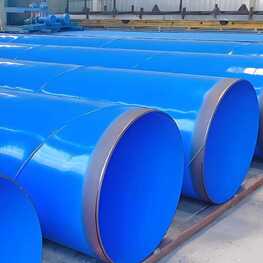
The strength of 3PE coating lies in the integration of three materials: epoxy powder, modified adhesive (AD), and high-density polyethylene (PE).
| Coating Structure | Core Function | Material Manager Control Points |
|---|---|---|
| Layer 1: Fusion Bonded Epoxy (FBE) | Provides strong adhesion and excellent cathodic disbondment resistance | Thickness must be ≥ 80 μm; strictly prohibit mixing with recycled or reclaimed powder |
| Layer 2: Adhesive (AD) | Acts as a bonding bridge, fusing and locking FBE and PE layers together | Thickness typically 170–250 μm; ensure application is carried out while the FBE layer is still in a gel state |
| Layer 3: Polyethylene (PE) | Provides resistance to soil stress, waterproofing, and mechanical protection | Strictly verify total coating thickness according to pipe diameter (typically 1.8–3.7 mm); prevent use of recycled or contaminated plastic materials |
Some unscrupulous manufacturers may reduce the thickness of expensive fusion bonded epoxy powder and adhesive layers, and compensate by increasing the amount of low-cost polyethylene to meet the total thickness requirement. Although the overall coating thickness may appear compliant, the interlayer bonding strength drops significantly. As a result, after several years of burial, the coating may peel off in large sections—much like “peeling a banana.”
To facilitate field welding, a bare steel cutback of 100–150 mm must be reserved at both pipe ends. The transition area must be ground into a smooth bevel with an angle of less than 30°. If the bevel is too steep or contains burrs, edge lifting and coating damage are highly likely during transportation and lifting.
This is a non-negotiable quality control step. Every finished pipe must pass a 25 kV high-voltage holiday detection test across the entire coated surface. If there is even a pinhole or micro-defect in the coating, the high-voltage current will break through the air gap, generate a spark, and trigger an alarm.
To ensure that the procured 3PE coated steel pipes fully comply with requirements, it is recommended to strictly control the following three aspects during tendering and final acceptance:
Ensure that the epoxy powder, adhesive, and polyethylene granules used by the manufacturer are sourced from Class I/II approved suppliers of PetroChina or Sinopec, or internationally recognized brands. This effectively eliminates the risk of inferior recycled materials entering production at the source.
This is considered the “gold standard” for evaluating 3PE coating quality. The technical specification should require a 60°C, 30-day cathodic disbondment test, and the disbondment radius must strictly comply with applicable national or international standards.
For high-pressure natural gas pipelines or high-sulfur crude oil transmission pipelines, the materials department should appoint an independent third-party inspection agency to conduct continuous on-site supervision at critical stages, including blasting, heating, and coating application. Daily process parameters should be recorded and archived in a structured format for traceability.
 WeChat
 Scan wechat
WhatsApp:+86 15383177997
E-mail:wr@insulatedpipeline.com
E-mail:
Address:Development Zone, Cangzhou, Hebei Province, China
技术支持:沧州利畅网络