EMAIL:
wr@insulatedpipeline.com



Number of visits:4 seconds Update time:2026-07-24
In projects such as long-distance water conveyance, oil and gas transmission, and municipal pipeline networks, selecting the right pipeline corrosion protection technology has always been a key factor in determining project quality and service life. There are three common types of corrosion protection on the market: 3PE, FBE, and TPEP.
Many buyers and engineers often get confused when faced with these three acronyms. This article uses plain, easy-to-understand language to thoroughly break down the differences between them, helping you select the most suitable and cost-effective solution when making project decisions.
FBE (Single-Layer Fusion-Bonded Epoxy Powder): This corrosion protection technology can be applied to both the inner and outer walls. Epoxy powder is sprayed onto the surface of steel pipes at high temperatures, curing to form a hard, ceramic-like shell. It bonds extremely well to the steel pipe and is resistant to chemical corrosion; however, the coating is relatively thin and susceptible to damage from impacts during transportation and construction.
3PE (Three-Layer Polyethylene): This is a corrosion protection technology specifically designed for the outer walls of steel pipes. It consists of three layers: an epoxy powder base layer, an adhesive middle layer, and a thick outer layer of high-density polyethylene (HDPE). Its outer shell is extremely hard, specifically engineered to withstand complex underground soil conditions and rock compression.
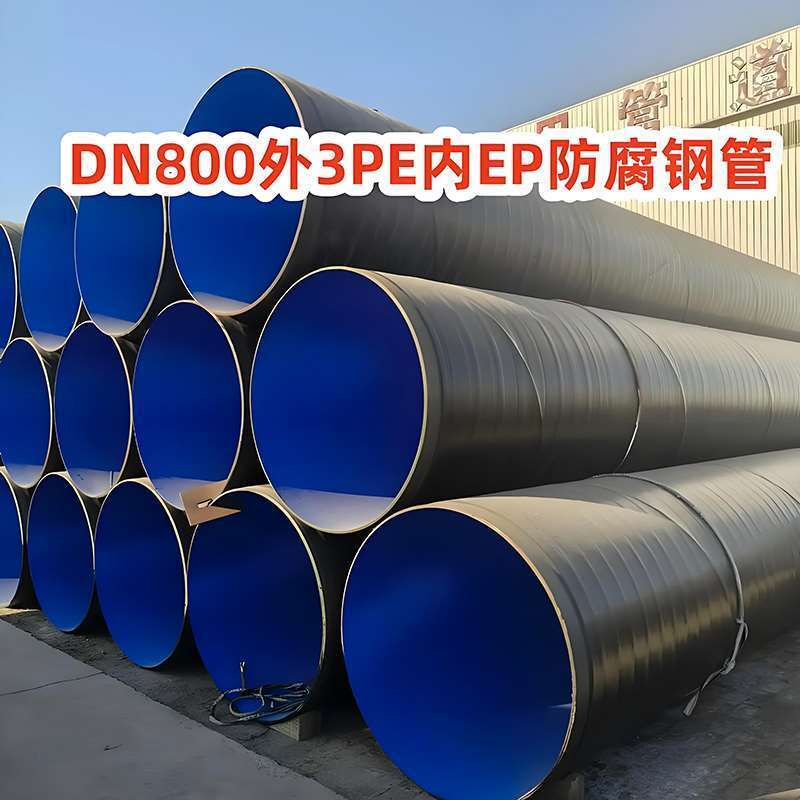
TPEP (Dual Internal and External Corrosion Protection): This is the “ultimate evolved combination” of the previous two technologies. The essence of TPEP-coated steel pipes lies in “3PE on the outer wall and FBE on the inner wall.” Through advanced processes, a single pipe simultaneously achieves hard plastic shell protection on the outer wall and ceramic-grade smooth corrosion protection on the inner wall.
| Performance Aspect | FBE (Fusion Bonded Epoxy Coating) | 3PE (Three-Layer Polyethylene Coating) | TPEP (Internal & External Composite Coating) | Buyer Decision Reference |
|---|---|---|---|---|
| Corrosion Protection Coverage | Single-layer coating, generally applied only to the external surface or internal surface. | Applied only to the external surface; the internal surface is not protected. | Provides complete internal and external corrosion protection (external 3PE + internal FBE). | For projects requiring both internal and external corrosion resistance, such as water transmission and oil pipelines, TPEP provides the most comprehensive protection. |
| Mechanical Impact Resistance | Relatively lower resistance; the coating can be scratched or damaged by hard objects. | Excellent impact resistance; the 2–3 mm polyethylene outer layer provides strong protection against impact and abrasion. | Excellent impact resistance (the external surface also features the durable 3PE protective layer). | For harsh geological conditions with gravel, rocks, or difficult backfilling environments, 3PE and TPEP provide more reliable protection. |
| Flow Efficiency / Friction Reduction Performance | Good (when applied as an internal coating). | None (an external coating system that does not affect internal flow conditions). | Excellent (the smooth internal FBE lining provides an ultra-low friction surface). | For long-term water transmission projects, TPEP can significantly reduce pumping energy costs due to its extremely smooth inner surface. |
| Designed Service Life | Approximately 20–30 years. | Approximately 30–50 years. | More than 50 years. | For critical infrastructure projects requiring decades of maintenance-free operation, TPEP is the preferred choice. |
If you cut open a cross-section of the pipe, the layers are arranged as follows:
FBE Structure: Steel pipe + epoxy powder layer (single-layer protection).
3PE Structure: Steel pipe + epoxy powder + adhesive + polyethylene shell (three-layer outer wall).
TPEP Structure: Internal epoxy powder + spiral-welded steel pipe + external epoxy powder + adhesive + polyethylene shell.
Key Point: In large-diameter water conveyance projects or gas trunk lines, spiral-welded steel pipes are typically selected as the base pipe due to their physical advantages of high pressure resistance and tensile strength. When combined with the TPEP process to form TPEP-coated spiral-welded steel pipes, the steel pipe itself is completely sandwiched between the inner and outer interwoven anti-corrosion layers, coming into contact neither with water nor soil, thereby ensuring 50 years of rust-free service.
The choice of technology depends on your project type, budget, and expected pipeline lifespan:
1. When Should You Choose FBE?
Scenarios: Small urban gas service lines, chemical pipelines within factories, or projects with excellent geological conditions where the backfill consists entirely of fine sand.
Reason: When the budget is limited and the construction process allows for precise hoisting without severe impacts, single-layer FBE offers a high cost-performance ratio.
2. When to Choose 3PE?
Scenarios: Long-distance buried natural gas pipelines, subsea oil pipelines (where the transported medium itself is not highly corrosive, and protection is primarily needed against soil and seawater erosion).
Reason: 3PE is the industry gold standard for external corrosion protection. As long as the liquid transported inside the pipe is not highly corrosive, 3PE provides an effective external barrier.
3. When Is TPEP a Must?
Scenarios: Long-distance interregional water diversion projects, urban water supply trunk lines, and industrial wastewater discharge pipelines.
Reason: Water supply projects require the inner wall to be absolutely hygienic, free of scale buildup, and non-contaminating to water quality, while also requiring low flow resistance to save on electricity costs; wastewater projects, meanwhile, require inner walls that are resistant to acids and alkalis. Only TPEP technology can address this dual-harsh environment, where the pipeline faces fluid erosion internally and soil corrosion externally.
 WeChat
 Scan wechat
WhatsApp:+86 15383177997
E-mail:wr@insulatedpipeline.com
E-mail:
Address:Development Zone, Cangzhou, Hebei Province, China
技术支持:沧州利畅网络