EMAIL:
wr@insulatedpipeline.com


Published:2026-08-18 | Last Updated: 2026-08-18 Views: 4
3PE-coated SSAW steel pipe is a piping product that combines the load-bearing capacity of SSAW spiral welded steel pipe with a 3PE external anti-corrosion system.
The steel pipe itself bears the pressure generated by the conveyed medium as well as external loads, while the 3PE coating primarily serves to isolate the steel pipe from soil, moisture, and other corrosive environments, thereby reducing the risk of external corrosion.
When purchasing 3PE-coated SSAW steel pipes, one should not focus solely on the term “3PE”; it is also necessary to verify the pipe standard, steel grade, outer diameter, wall thickness, coating grade, coating thickness, testing requirements, and end treatment method.
3PE-Coated SSAW Steel Pipe consists of two main components:
SSAW Steel Pipe: Spiral submerged arc welded steel pipe, also known as Spiral Submerged Arc Welded Steel Pipe.
3PE Coating: A three-layer polyethylene external anti-corrosion coating.
SSAW steel pipes are typically manufactured from steel coils, which are formed into pipe bodies through spiral forming and submerged arc welding. Compared to small-diameter steel pipes, spiral welded steel pipes are particularly well-suited for large-diameter pipeline projects.
After the steel pipes are manufactured and undergo the necessary inspections, they can undergo surface treatment and 3PE anti-corrosion coating.
Therefore, 3PE-Coated SSAW Steel Pipe is not a standalone steel standard, but rather:
SSAW steel pipe + 3PE external anti-corrosion coating
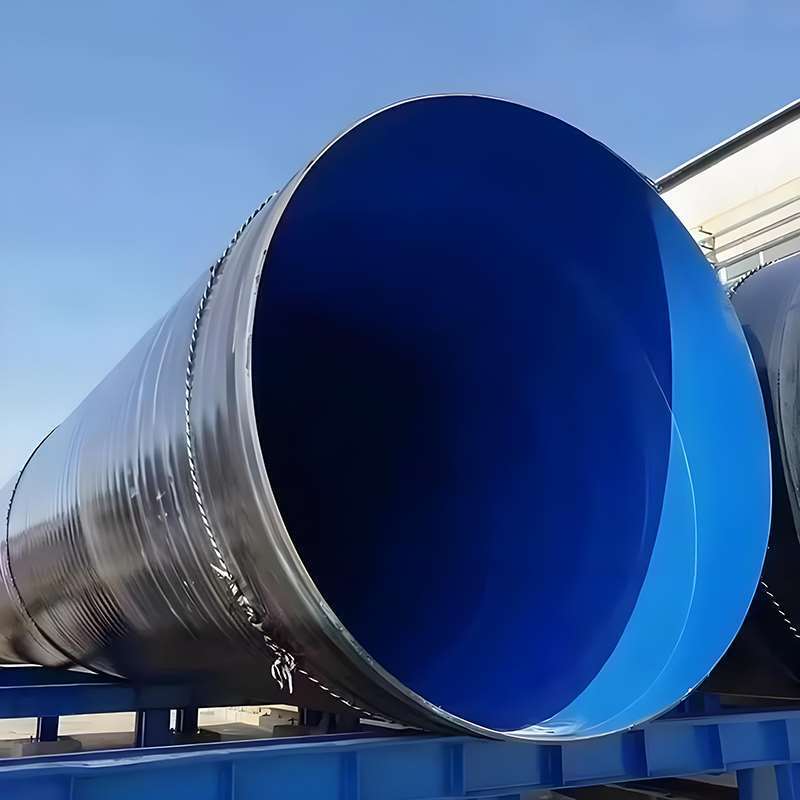
| Parameter | Range / Description |
|---|---|
| Product Name | 3PE Coated Spiral Welded Steel Pipe |
| Pipe Type | SSAW (Spiral Submerged Arc Welded) Steel Pipe |
| Outside Diameter | 219–3620 mm |
| Wall Thickness | 5–25 mm |
| Single Pipe Length | 5.8–12 m, customizable according to project requirements |
| Steel Grade | Q235B, Q355B, API 5L Gr.B, X42, X52, X60, X65, etc. |
| Pipe Standards | API 5L, GB/T 9711, ASTM, etc., according to project requirements |
| Anti-Corrosion Type | 3PE / 3LPE Three-Layer Polyethylene Coating |
| Coating Structure | Fusion Bonded Epoxy (FBE) + Adhesive + Polyethylene (PE) |
| Coating Thickness | Determined according to pipe diameter, coating grade, and project specifications |
| Surface Preparation | Abrasive blasting, typically to Sa 2.5, or according to project requirements |
| Welding Process | Submerged Arc Welding (SAW) |
| Pipe Ends | Plain ends or beveled ends, customizable according to project requirements |
| Weld Inspection | Ultrasonic Testing (UT), Radiographic Testing (RT), or other NDT methods as required by applicable standards |
| Hydrostatic Test | Performed according to the applicable pipe standard and project specifications |
| Coating Inspection | Coating thickness, holiday detection, adhesion testing, and other specified tests |
| Material Certificate | EN 10204 3.1 or as required by the project |
| Third-Party Inspection | SGS, BV, Intertek, or other third-party inspection agencies can be arranged upon request |
| Main Applications | Water transmission pipelines, oil pipelines, natural gas pipelines, municipal projects, industrial pipelines, and buried pipelines |
| Packaging | Bare pipe, bundled, or packaged according to transportation requirements |
| Customization | Outside diameter, wall thickness, length, steel grade, and 3PE coating requirements can be customized according to project specifications |
Steel pipe → FBE epoxy powder → Adhesive → Polyethylene (PE)
1. First layer: FBE epoxy powder layer
The first layer is fusion-bonded epoxy powder, which is applied directly to the surface-treated steel pipe.
The primary functions of the FBE layer are:
To form a strong bond with the steel pipe substrate;
To provide a basic corrosion protection barrier;
To reduce the penetration of moisture, oxygen, and corrosive media into the steel surface;
To provide a solid bonding foundation for the subsequent adhesive layer.
Therefore, the FBE layer primarily addresses the issues of adhesion between the steel pipe and the protective coating, as well as basic corrosion protection.
2. Second Layer: Adhesive Layer
The second layer is the adhesive, located between the FBE layer and the PE layer.
Due to the differences in the properties of epoxy and polyethylene, the two materials cannot form a reliable bond through simple contact alone. The adhesive layer enhances the adhesion between the FBE and PE, enabling the three-layer coating to form a stable, integrated structure.
Therefore, the adhesive layer primarily serves to bond the layers together.
3. Third Layer: Polyethylene (PE) Layer
The outermost layer is the polyethylene layer, which is also the layer of the 3PE coating that directly faces the external environment.
The PE layer is primarily used to:
Barrier against moisture and corrosive media;
Provide good environmental resistance;
Enhance the coating’s mechanical protection;
Reduce damage to the internal anti-corrosion layer during transportation, installation, and backfilling.
Therefore, the PE layer primarily addresses issues related to isolation from the external environment and mechanical protection.
4. How do the three layers work together?
The 3PE coating is not simply a layering of three materials; rather, it forms a complete corrosion-resistant system through the distinct functions of each layer:
| Coating Layer | Main Material | Main Function |
|---|---|---|
| First Layer | FBE Epoxy Powder | Bonds to the steel pipe and provides the primary corrosion protection |
| Second Layer | Adhesive | Enhances the interlayer bonding between the FBE and PE layers |
| Third Layer | Polyethylene (PE) | Isolates the pipe from the external environment and provides mechanical protection |
.jpg)
1. Isolation from Moisture and Corrosive Media
Once steel pipes are buried underground, their outer surfaces are continuously exposed to moisture, oxygen, salts, and other corrosive substances in the soil. The 3PE coating reduces direct contact between these media and the steel, thereby lowering the likelihood of external corrosion.
2. Reducing the Risk of External Corrosion in Steel Pipes
If steel pipes are exposed to damp or corrosive soil environments for extended periods, the bare steel surface is prone to corrosion. The 3PE coating forms a corrosion-resistant barrier through its multi-layer structure, helping to protect the steel pipe substrate. It is particularly suitable for buried pipelines that require external corrosion protection.
3. Providing Mechanical Protection
During transportation, loading/unloading, installation, and backfilling, the coating may be subjected to impacts, friction, or compression from soil and rock. The outermost PE layer provides excellent mechanical protection, reducing the risk of damage to the internal corrosion-resistant layers during external construction processes.
4. Enhancing the Reliability of Long-Term Corrosion Protection Systems
3PE does not rely solely on the PE layer for corrosion protection; rather, it consists of three layers—FBE, adhesive, and PE—that work together. FBE provides adhesion to the steel pipe and basic corrosion protection, the adhesive enhances interlayer bonding, and PE provides external isolation and mechanical protection.
1. Long-Distance Water Transmission Pipelines
Used in projects such as urban water supply, raw water transmission, interregional water transfer, and industrial water supply.
Why They Are Suitable:
These pipelines typically have large diameters and long routes, and many must be buried underground for extended periods. SSAW steel pipes meet the requirements for large-diameter transmission, while the 3PE coating reduces the risk of corrosion caused by external factors such as soil and moisture.
Key Considerations for Selection:
Pipe diameter, wall thickness, water transmission pressure, steel grade, 3PE coating requirements, and the pipeline’s burial environment.
2. Oil Transmission Pipelines
These can be used for long-distance transmission of crude oil and certain petroleum products.
Why 3PE Is Needed:
Oil pipelines typically require long-term operation; once corrosion occurs on the outer surface of the steel pipe, the costs of subsequent maintenance and replacement can be high. Therefore, for buried pipelines, the external anti-corrosion coating is a key consideration.
Key Considerations for Selection:
Applicable steel pipe standards (such as API 5L), steel grade, wall thickness, design pressure, 3PE coating standards, and testing requirements.
3. Natural Gas Transmission Pipelines
Long-distance natural gas transmission pipelines typically have strict project requirements regarding steel pipe quality and corrosion protection systems.
Why Corrosion Protection Matters:
Natural gas pipelines may be buried in soil for extended periods, and the outer surface of the steel pipes is subject to moisture, soil, and other environmental factors. A 3PE coating can serve as part of the external corrosion protection system to reduce the risk of external corrosion of the steel pipes.
Key considerations during selection:
Do not base your selection solely on pipe diameter and price; you should also verify the steel grade, wall thickness, pipeline design pressure, steel pipe standards, 3PE standards, and testing requirements.
4. Municipal Water Supply and Infrastructure Projects
Suitable for urban water supply, industrial park water supply, and other large-diameter municipal water transmission projects.
Why It’s Worth Considering:
Municipal pipelines typically require long-term use, and maintenance is often constrained by roads, buildings, and other underground facilities. For steel pipes intended for underground installation, implementing external corrosion protection in advance can reduce the risks associated with future maintenance.
5. Industrial Transmission Pipelines
Suitable for certain industrial transmission systems in sectors such as mining, power generation, steel, and chemicals.
Important Note:
The transmission media in industrial projects vary widely, and not all industrial pipelines are suitable for 3PE. Therefore, the temperature, pressure, and corrosiveness of the medium should be confirmed first before determining whether 3PE meets the project requirements.
6. Other Large-Diameter Buried Transmission Pipelines
For projects requiring large-diameter, long-distance transmission with external corrosion protection requirements, 3PE-coated SSAW steel pipes may also be considered.
For example:
Water resource transmission projects
Raw water pipelines
Industrial circulating water pipelines
Mining water supply pipelines
Certain underground energy transmission pipelines
| Inspection Category | Inspection Item | Common Standards / Basis | Main Inspection Content |
|---|---|---|---|
| Steel Pipe Body | Chemical Composition | API 5L, GB/T 9711, etc. | Verify that the chemical composition of the steel meets the requirements of the specified steel grade |
| Steel Pipe Body | Mechanical Properties | API 5L, GB/T 9711, etc. | Check yield strength, tensile strength, elongation, and other mechanical properties |
| Dimensional Inspection | Outside Diameter, Wall Thickness, Length | Applicable pipe standards | Verify pipe dimensions and allowable tolerances |
| Weld Inspection | Non-Destructive Testing (NDT) | API 5L, GB/T 9711, and project requirements | Check the spiral weld for defects |
| Hydrostatic Test | Hydrostatic Pressure Test | API 5L, GB/T 9711, etc. | Verify the pressure resistance and leak-tightness of the steel pipe |
| Surface Preparation | Abrasive Blasting | ISO 8501-1, etc. | Check the cleanliness of the steel pipe surface |
| 3PE Coating | Coating Thickness | ISO 21809-1 and project requirements | Verify that the 3PE coating thickness meets the specified requirements |
| 3PE Coating | Visual Inspection | ISO 21809-1 and project requirements | Check whether the coating is uniform and free from bubbles, cracks, and other defects |
| 3PE Coating | Holiday Detection | ISO 21809-1 and project requirements | Check the coating for pinholes, holidays, and areas of insufficient coating |
| 3PE Coating | Adhesion | ISO 21809-1 and project requirements | Check the bonding between the anti-corrosion coating and the steel pipe |
| 3PE Coating | Cathodic Disbondment | ISO 21809-1 and project requirements | Evaluate the stability of the coating under cathodic protection conditions |
| Final Inspection | Documentation and Marking | EN 10204 and project requirements | Check the MTC, inspection reports, product markings, and other required documents |
3PE corrosion-resistant spiral-welded steel pipes are steel pipes with a three-layer polyethylene (PE) anti-corrosion coating applied to the outer surface of SSAW spiral-welded steel pipes.
The 3PE coating typically consists of three layers: FBE epoxy powder, an adhesive, and polyethylene (PE). It is primarily used to reduce the risk of external corrosion in steel pipes and is suitable for water transmission, oil, natural gas, and other underground pipeline projects.
Yes, they are. The 3PE coating is primarily used for external corrosion protection; it reduces direct contact between the pipe and moisture, oxygen, and corrosive substances in the soil, making it commonly used for underground transmission pipelines.
However, in actual use, factors such as soil conditions, operating temperature, cathodic protection, and on-site construction quality must also be considered; the overall corrosion protection lifespan of the pipeline cannot be determined based solely on the 3PE coating.
There is no fixed thickness for 3PE coatings that applies to all projects. The actual thickness must be determined based on the steel pipe diameter, coating grade, applicable standards, and project technical requirements.
Therefore, when purchasing, it is best to specify the following:
3PE standard + coating grade + minimum coating thickness
rather than simply stating “3PE coated.”
FBE is a fusion-bonded epoxy powder coating, while 3PE is a three-layer corrosion protection system consisting of FBE + adhesive + PE.
Simply put:
FBE primarily provides adhesion to the steel pipe and basic corrosion protection; the adhesive ensures interlayer bonding; and PE provides external isolation and mechanical protection.
Therefore, 3PE is not a simple PE coating, but a multi-layer composite corrosion protection system.
In addition to quality inspections of the steel pipe itself, the corrosion-resistant coating must also be inspected.
For the steel pipe body, attention is typically focused on chemical composition, mechanical properties, dimensions, weld quality, and hydrostatic pressure testing.
For the 3PE coating, tests such as coating thickness, appearance, pinholes, adhesion, impact resistance, and cathodic delamination may be conducted based on project requirements.
Specific test items should be determined in accordance with applicable standards and project technical specifications.
To obtain an accurate quote, it is recommended to provide at least the following:
Outer Diameter + Wall Thickness + Length + Steel Grade + Steel Pipe Standard + 3PE Standard + Coating Thickness + Pipe End Type + Quantity + Inspection Requirements + Delivery Location
Among these, the steel pipe standard and the 3PE coating standard are particularly important.
For example, simply providing “3PE Coated SSAW Steel Pipe, OD 1000 mm” is usually insufficient for an accurate quote, as key information such as wall thickness, steel grade, length, and coating requirements is missing.
 WeChat
 Scan wechat
WhatsApp:+86 15383177997
E-mail:wr@insulatedpipeline.com
E-mail:
Address:Development Zone, Cangzhou, Hebei Province, China
技术支持:沧州利畅网络
.jpg)
.jpg)