EMAIL: wr@insulatedpipeline.com
Position:Home > Insulated Steel Pipe News > What Standards and Insulation Performance Should a Pre Insulated Pipe System Meet for Long-Distance Transport?

What Standards and Insulation Performance Should a Pre Insulated Pipe System Meet for Long-Distance Transport?

Number of visits:3 seconds Update time:2026-06-29

For long-distance pre-insulated pipeline networks—such as intercity district heating systems, large-scale regional cooling projects, and crude oil transmission pipelines—the extreme transport distance, massive capital investment, and complex geological conditions impose exceptionally stringent requirements on system safety, durability, and thermal efficiency.

In long-distance operation, even a reduction of 0.01 W/(m·K) in thermal conductivity, or a 1% decrease in total heat loss, can translate into millions of dollars in energy savings over a multi-decade service life.

This article analyzes the selection and evaluation criteria for long-distance pre-insulated pipe systems from three key perspectives: core international standards, critical thermal insulation performance requirements, and system-specific design considerations.


I. Essential Standards for Long-Distance Pipeline Systems

The design and procurement of long-distance pipeline systems must strictly comply with both domestic and international standards. These standards define not only dimensional requirements but also minimum service life under complex stress conditions.

1. Chinese National Standards (GB/T & CJ/T)

In China, district heating and long-distance pipeline systems primarily follow:

GB/T 29047-2021
Pre-insulated directly buried district heating pipe systems with high-density polyethylene outer casing and polyurethane foam insulation
This is the core standard for directly buried heating pipelines in China. It defines detailed physical and chemical performance requirements for the carrier steel pipe, polyurethane insulation layer, and HDPE outer jacket.

CJ/T 200-2004
Technical specification for pre-insulated directly buried steam pipe systems for urban heating
This standard applies to high-temperature steam transmission (150°C–350°C) and regulates the design and manufacturing of steel-jacketed composite insulation systems.

2. International and Industry Standards (EN & API)

For international projects or high-spec applications, the following standards are commonly adopted:

EN 253
A European standard for district heating pipe systems, widely recognized as one of the most stringent global benchmarks for polyurethane pre-insulated pipes. It places strong emphasis on shear strength and design service life, requiring continuous operation at 120°C for at least 30 years.

API 5L (Line Pipe Specification)
Carrier steel pipes used in long-distance transmission—especially for high-pressure crude oil or large-diameter hot water pipelines—are typically required to comply with API 5L grades such as X42, X52, or X60, ensuring sufficient tensile strength and pressure resistance.


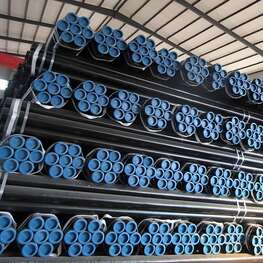
Pre Insulated Pipe System

II. Thermal Insulation Performance and Physical Property Requirements

The key challenge in long-distance transmission is temperature control. A high-performance insulation system must meet the following strict requirements:

1. Extremely Low Thermal Conductivity

Thermal conductivity is the most direct indicator of insulation performance.

  • Requirement:
    At ambient temperature, high-quality rigid polyurethane foam should have a thermal conductivity ≤ 0.024 W/(m·K).

    Under full operating conditions at 50°C, the overall system thermal conductivity must not exceed 0.027 W/(m·K).

  • Steam systems:
    In steel-jacketed steam pipelines, inner insulation materials such as aluminum silicate or microporous calcium silicate typically exhibit thermal conductivity around ≤ 0.06 W/(m·K) at 100°C.

2. High Closed-Cell Content and Foam Density

Moisture ingress is one of the most critical threats in long-distance pipelines, as it can rapidly degrade insulation performance.

  • Closed-cell content: ≥ 88% (high-spec projects require ≥ 90%)

  • Foam density: ≥ 60 kg/m³ for buried pre-insulated pipelines

Low-density foam can lead to structural deformation under soil load, potentially causing cracking of the outer casing.

3. Long-Term Thermal Stability

Once installed underground, long-distance pipeline systems are extremely difficult to replace or repair.

  • The insulation system must maintain structural integrity under continuous operation at 120°C–130°C for more than 30 years.

  • Thermal degradation shall not exceed 10% of the initial insulation performance over the design life.


III. System-Level Performance Requirements for Long-Distance Networks

Compared with local distribution systems, long-distance pipeline networks must satisfy additional system-level performance criteria due to varying terrain, stress conditions, and operational complexity.

1. Integrated Shear Strength (Three-Component Interaction)

In directly buried long-distance pipelines, axial thermal expansion generates significant stress. This stress must be transferred and dissipated through the interaction between the steel carrier pipe, polyurethane insulation layer, and HDPE outer casing.

  • Technical requirement:
    According to GB/T 29047 and EN 253, axial shear strength at 23°C must be ≥ 0.12 MPa, and at maximum operating temperature must remain ≥ 0.08 MPa.

Insufficient shear strength may result in “core separation” (debonding between steel pipe and insulation), which severely compromises both thermal and corrosion protection performance.

2. Full-Line Embedded Leak Detection System

For pipeline networks extending tens or even hundreds of kilometers, manual inspection alone cannot detect minor underground leakage.

  • Requirement:
    Modern pre-insulated pipelines must include embedded alarm wires (typically two parallel stainless steel or copper wires), compliant with EN 14419.

  • The system should use Time Domain Reflectometry (TDR) for full-line monitoring.

  • In case of water ingress or outer casing damage, the system must trigger an alarm within seconds and locate the leak within ±1 meter accuracy.

3. Resistance to Environmental Stress Cracking (Outer Jacket)

Long-distance pipelines often pass through diverse geological zones such as sand, clay, and saline-alkali soils, exposing the HDPE outer casing to long-term ground stress.

  • Material requirement: virgin HDPE material only

  • Elongation at break: ≥ 350%

  • ESCR (Environmental Stress Cracking Resistance): ≥ 300 hours

These requirements ensure that the outer casing will not develop brittle cracks under uneven settlement or long-term soil shear forces over a 30-year service life.


IV. Procurement Recommendations

For procurement and engineering teams responsible for long-distance pipeline projects, the technical specification should be structured around the following three steps:

Step 1: Define Applicable Standards

Clearly specify compliance with API 5L / GB/T 29047 / EN 253, depending on pressure and temperature requirements.

Step 2: Verify Physical and Chemical Performance

Strictly review type test reports for:

  • Thermal conductivity (≤ 0.027 W/(m·K))

  • Closed-cell content

  • Axial shear strength

Step 3: Control System Components

  • Require factory-installed alarm wire systems supplied with the pipe

  • Ensure field joints use electrofusion sleeve technology for consistent sealing performance


Long-distance pre-insulated pipe systems are not merely thermal products—they are long-life engineering infrastructure systems. Proper standard selection, insulation performance verification, and system-level design control are essential to ensuring decades of safe and efficient operation.


cache
Processed in 0.006601 Second.